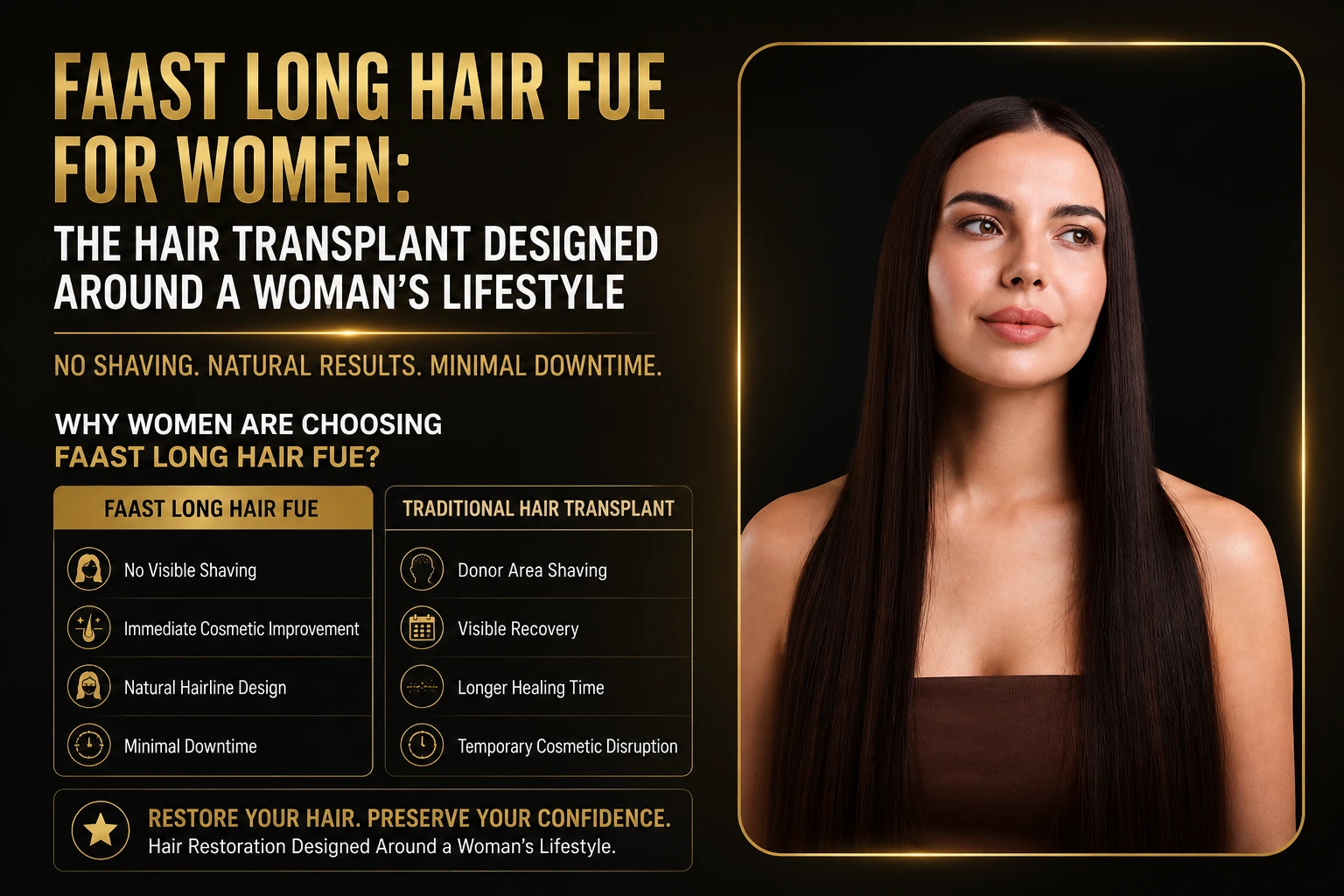
FAAST Long Hair FUE for Women: The Hair Transplant Designed Around a Woman's Lifestyle
Hair loss in women is often very different from hair loss in men.
While men commonly develop visible bald patches and receding hairlines, women usually experience:
- Diffuse thinning
- Widening of the hair partition
- Reduced hair volume
- Thinning around the temples
- Hairline recession
- Hair loss due to traction hairstyles
- Hair loss following hormonal changes
Yet despite significant emotional distress, many women delay seeking hair transplant surgery.
The reason is surprisingly simple.
Most women cannot imagine shaving their hair for a hair transplant.
For many female patients, the thought of visible surgery, donor shaving, and weeks of recovery becomes a bigger concern than the hair loss itself.
This is where FAAST Long Hair FUE (Follicle Activated Advanced Synchronized Transplant) is changing the landscape of female hair restoration.
Why Hair Loss Affects Women Differently
Hair is deeply connected to identity, femininity, confidence, and self-expression.
Women often spend years trying:
- Hair extensions
- Hair fibers
- Hair toppers
- Camouflaging hairstyles
- Volumizing products
before considering surgical restoration.
Unlike men, female hair loss is often hidden from others but constantly visible to the woman experiencing it.
Many women report:
- Avoiding certain hairstyles
- Constantly adjusting their hair partition
- Feeling self-conscious in photographs
- Anxiety about windy weather
- Reduced confidence in social settings
Hair restoration for women therefore requires not just surgical expertise but also a deep understanding of the emotional impact of hair loss.
Why Traditional Hair Transplants Can Be Challenging for Women
Conventional hair transplant techniques often require:
- Shaving the donor area
- Trimming recipient zones
- Temporary cosmetic disruption
For many women, this is unacceptable.
For many women, this is unacceptable. Common concerns include:
"How will I hide the shaved area?"
"Will people notice I've had surgery?"
"How long before I can return to work?"
"What if my hair never looks normal again?"
These concerns have prevented countless women from pursuing effective hair restoration.
What Is FAAST Long Hair FUE?
FAAST stands for:
Follicle Activated Advanced Synchronized Transplant
It is an advanced evolution of FUE hair transplantation that allows:
- Long hair extraction
- Long hair implantation
- Minimal visible signs of surgery
- Immediate aesthetic improvement
- Preservation of existing hairstyle
Unlike traditional FUE, transplanted grafts retain their hair shafts, allowing patients to visualize density immediately after the procedure.
Why FAAST Long Hair FUE Is Ideal for Women
1. No Need for Visible Shaving
Perhaps the biggest advantage for women is discretion.
The visible hairstyle remains largely unchanged.
This allows patients to:
- Continue social activities
- Return to professional life quickly
- Avoid awkward questions
- Maintain privacy
For many women, this benefit alone makes FAAST Long Hair FUE a game changer.
2. Immediate Visual Improvement
One of the most frustrating aspects of traditional hair transplantation is waiting months to appreciate the cosmetic outcome.
With FAAST Long Hair FUE:
- The transplanted hair is visible immediately
- Hairline improvements can be appreciated instantly
- Density enhancement is easier to visualize
Although the transplanted hairs will eventually shed as part of the normal growth cycle, patients enjoy an immediate preview of the expected outcome.
3. Particularly Effective for Hairline Restoration
Women frequently seek correction for:
- High forehead
- Receded temples
- Uneven hairline
- Congenital high hairline
Hairline design in women requires exceptional precision.
A few millimeters can dramatically influence facial harmony.
FAAST Long Hair FUE allows precise placement and real-time visualization during surgery.
4. Better Preservation of Existing Hair
Unlike male pattern baldness, female hair loss often occurs in areas where hair is still present but significantly thinned.
This creates unique surgical challenges.
The surgeon must:
- Navigate existing hairs
- Avoid damaging native follicles
- Create density between existing strands
The FAAST protocol is designed to accommodate these complexities.
Why Female Hair Transplants Require More Expertise
Hair transplantation in women is often more technically demanding than in men.
Challenges include:
Diffuse Thinning
Women often lack completely bald areas.
Higher Shock Loss Risk
Native hairs may be more vulnerable during implantation.
Hairline Design Complexity
Female hairlines must appear soft, natural, and age-appropriate.
Underlying Hair Disorders
A proper diagnosis is essential before surgery.
The surgeon must understand:
- Female pattern hair loss
- Traction alopecia
- Frontal fibrosing alopecia
- Chronic telogen effluvium
- Hormonal influences
This is why expertise in both dermatology and hair transplantation is particularly important.
FAAST Long Hair FUE vs Traditional Female Hair Transplant
Conventional FUE
Advantages
- Effective restoration
- No linear scar
Limitations
- Shaving often required
- Visible postoperative appearance
FUT (Strip Method)
Advantages
- Large graft numbers possible
Limitations
- Linear scar
- Longer recovery
- Less popular among women
FAAST Long Hair FUE
Advantages
- Maximum discretion
- No obvious cosmetic disruption
- Immediate visual density
- Faster return to normal activities
- Better suited for professional women
- Excellent for hairline restoration
The Role of Sapphire Blade Technology
At The Éterne Clinic, FAAST Long Hair FUE incorporates sapphire blade slitting technology.
This allows:
- Smaller recipient sites
- More precise implantation
- Higher density potential
- Better graft angulation
- Natural-looking hair direction
For female hairline restoration, these details make a significant difference.
Who Is an Ideal Candidate?
FAAST Long Hair FUE may be suitable for women experiencing:
Female Pattern Hair Loss
Early to moderate thinning with stable donor areas.
Traction Alopecia
Hair loss caused by tight hairstyles.
High Forehead
Hairline advancement procedures.
Temple Recession
Loss of density around the frontal corners.
Scar Camouflage
Concealing scars within the scalp or hairline.
A comprehensive consultation is essential to determine candidacy.
Why Women Are Choosing The Éterne Clinic
At The Éterne Clinic, Powai, female hair restoration is approached differently.
Our focus extends beyond simply transplanting grafts.
We prioritize:
- Accurate diagnosis
- Hair disorder evaluation
- Long-term planning
- Natural hairline artistry
- Regenerative support
- Minimal downtime
We frequently combine FAAST Long Hair FUE with:
- I-PRF
- Exosome therapy
- Growth factor treatments
- Medical hair loss management
to optimize outcomes and support existing hair.
Read more from our FAAST & Hair Restoration blog series:
- FAAST Long Hair FUE vs. Standard Hair Transplant: What Makes It Different?
- Why Corporate Professionals Are Choosing FAAST Long Hair FUE
- Female Hairline Lowering: FAAST Long Hair FUE vs Forehead Reduction Surgery
- FAAST Long Hair FUE with Sapphire Blade Slitting: Achieving Maximum Density
- FAAST No-Shave Long Hair FUE at The Éterne Clinic
You may also like:
Why Celebrities Are Choosing FAAST
Long Hair FUE at The Éterne Clinic, Mumbai
Discover why actors, influencers, and public figures choose FAAST Long Hair FUE for discreet hair
restoration with immediate cosmetic improvement.
Final Thoughts
For many women, the biggest obstacle to hair transplantation has never been the procedure itself.
It's the fear of looking like they've had a procedure.
FAAST Long Hair FUE removes that barrier.
By preserving existing hairstyles, minimizing visible downtime, and delivering natural-looking density, it allows women to restore their hair with confidence and privacy.
Because the best hair transplant is one that fits seamlessly into a woman's life—not one that disrupts it.
Disclaimer
This article is intended solely for educational and informational purposes and should not be construed as medical advice, diagnosis, treatment recommendation, or a substitute for professional healthcare consultation. Individual results may vary. Hair transplant suitability, graft survival, recovery timelines, and aesthetic outcomes depend on individual factors including scalp characteristics, donor availability, underlying hair disorders, and overall health. Any medical or surgical treatment should only be undertaken after consultation with a qualified healthcare professional.