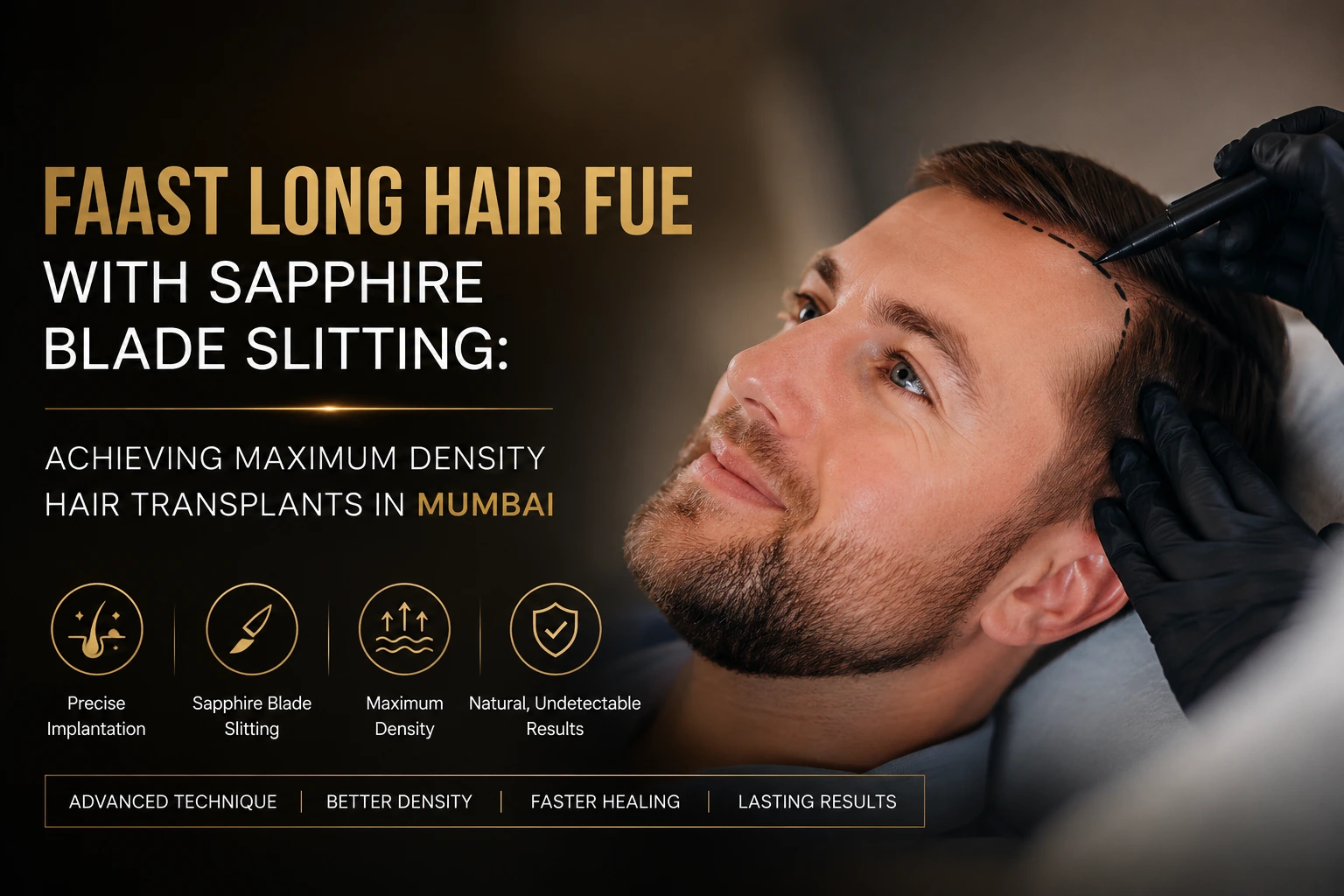
FAAST Long Hair FUE with Sapphire Blade Slitting: Achieving Maximum Density Hair Transplants in Mumbai
When patients think about hair transplantation, they often focus on one question:
“How many grafts will I need?”
While graft count is important, one of the most overlooked factors influencing the final outcome is how those grafts are implanted.
A natural-looking, dense hair transplant depends not only on follicle extraction but also on the precision of recipient site creation.
At The Éterne Clinic, Mumbai, the FAAST Long Hair FUE (Follicle Activated Advanced Synchronized Transplant) protocol incorporates advanced sapphire blade slitting technology to optimize graft placement, improve density, and enhance overall aesthetic outcomes.
For patients seeking undetectable hair restoration, this represents a significant advancement beyond conventional hair transplant techniques.
Why Density Matters More Than Graft Numbers
Many patients assume that more grafts automatically create better density.
In reality, successful hair restoration depends on several factors:
- Recipient site design
- Hairline architecture
- Graft angulation
- Direction of growth
- Graft survival
- Strategic distribution
- Existing native hair preservation
Even a large number of grafts can produce an unnatural appearance if recipient sites are poorly designed.
Conversely, expertly planned implantation can create the illusion of greater density using fewer grafts.
This is where sapphire blade technology becomes particularly valuable.
What Is Sapphire Blade Slitting?
Before hair follicles can be implanted, tiny channels or “slits” are created within the recipient area.
These recipient sites determine:
- Hair direction
- Hair angle
- Hair density
- Naturalness of growth
- Blood supply around grafts
Traditionally, these slits are created using steel blades.
FAAST Long Hair FUE utilizes ultra-precise sapphire blades to create recipient channels with greater accuracy and minimal tissue trauma.
Why Sapphire Blades Are Different
Sapphire blades are manufactured from synthetic sapphire crystals rather than conventional surgical steel.
Their unique properties allow surgeons to create:
- Smaller recipient channels
- Sharper and cleaner incisions
- More precise graft placement
- Reduced tissue trauma
- Better control over angulation
- Higher density packing potential
This enhanced precision becomes particularly important in advanced hair restoration procedures where every graft matters.
How Sapphire Blade Slitting Improves Density
1. Smaller Recipient Sites
One of the biggest advantages of sapphire blades is the ability to create narrower channels.
Smaller incisions allow:
- Closer graft placement
- More efficient use of available scalp area
- Better density without compromising blood supply
This is particularly valuable in:
- Hairline reconstruction
- Temple restoration
- Crown densification
- Female hair transplants
2. Enhanced Dense Packing
Dense packing refers to the ability to place grafts closer together while maintaining healthy circulation.
Because sapphire blades create cleaner and more refined channels:
- Grafts can be strategically positioned
- Natural density can be improved
- Hairline fullness can be enhanced
without creating excessive trauma.
3. Better Preservation of Blood Supply
Hair follicles are living structures that require oxygen and nutrients.
Excessive trauma during recipient site creation can compromise local blood circulation.
The precision of sapphire blade slitting helps preserve:
- Microvascular networks
- Tissue integrity
- Healing response
which supports graft survival and growth.
FAAST Long Hair FUE: Going Beyond Traditional FUE
While sapphire blades are valuable on their own, their benefits become even more significant when integrated into the FAAST protocol.
FAAST stands for: Follicle Activated Advanced Synchronized Transplant
This advanced approach combines:
- Long Hair FUE
- Sapphire blade slitting
- Advanced graft handling
- Regenerative support
- Precision implantation
to optimize both immediate and long-term outcomes.
The Unique Advantage of FAAST Long Hair FUE
Unlike conventional FUE procedures that require shaving and transplanting short grafts, FAAST Long Hair FUE allows:
Immediate Visualization
The implanted hair shafts remain visible immediately after transplantation.
This enables:
- Better density assessment
- Precise aesthetic refinement
- Improved hairline design
during the procedure itself.
No-Shave Aesthetic Advantage
Patients can maintain their existing hairstyle while undergoing treatment.
This makes FAAST particularly attractive for:
- Celebrities
- Business executives
- Public figures
- Women
- Brides and grooms
who cannot afford visible downtime.
Why Sapphire Blade Slitting Is Particularly Valuable in Long Hair FUE
Long Hair FUE is significantly more demanding than conventional transplantation.
The surgeon must carefully navigate:
- Existing native hair
- Long donor grafts
- Hair direction patterns
- Density optimization
Sapphire blade recipient sites allow:
- Greater precision
- Improved visualization
- Better graft accommodation
- More natural blending
with surrounding hair.
Faster Healing and Reduced Trauma
Another benefit frequently appreciated by patients is the healing experience.
Because sapphire blades create cleaner micro-incisions:
- Inflammation may be reduced
- Crust formation is minimized
- Healing is often faster
- Recovery can be more comfortable
This aligns perfectly with the FAAST philosophy of minimizing downtime.
The Role of Regenerative Medicine in FAAST
At The Éterne Clinic, FAAST Long Hair FUE is often integrated with regenerative treatments such as:
- I-PRF
- PRP
- Exosome therapy
- Growth factor support
These treatments may help:
- Improve graft survival
- Support healing
- Optimize scalp health
- Enhance overall outcomes
creating a comprehensive hair restoration strategy.
Who Is an Ideal Candidate?
FAAST Long Hair FUE with sapphire blade slitting may be particularly beneficial for:
Men with Receding Hairlines
Precise hairline reconstruction requires exceptional control over graft placement.
Women with Hair Thinning
Smaller recipient sites help preserve surrounding native hair.
Celebrities and Public Figures
Minimal visible downtime is a major advantage.
Patients Seeking Maximum Density
Strategic dense packing becomes more achievable with sapphire blade technology.
Hairline Refinement Cases
Where subtle aesthetic improvements make a significant difference.
Why The Éterne Clinic Uses Sapphire Blade Technology
Hair transplantation is both a medical procedure and an artistic discipline.
At The Éterne Clinic, Powai, our focus extends beyond graft numbers.
We prioritize:
- Natural aesthetics
- Long-term planning
- Donor area preservation
- Density optimization
- Precision hairline design
The use of sapphire blade slitting within the FAAST Long Hair FUE protocol reflects our commitment to combining surgical innovation with artistic excellence.
The Future of High-Density Hair Transplantation
Modern hair transplantation is no longer simply about filling bald areas.
Today’s patients expect:
- Naturalness
- Density
- Minimal downtime
- Undetectable results
- Long-term sustainability
FAAST Long Hair FUE with sapphire blade slitting represents a significant step toward achieving all of these goals simultaneously.
Because when it comes to hair restoration, precision often matters more than quantity.
Read more from our FAAST & Hair Restoration blog series:
- FAAST Long Hair FUE vs. Standard Hair Transplant: What Makes It Different?
- Why Corporate Professionals Are Choosing FAAST Long Hair FUE
- Exosome Therapy for Female Pattern Hair Loss in Mumbai
- Hair Transplant for Women
Disclaimer
This article is intended solely for educational and informational purposes and should not be construed as medical advice, diagnosis, treatment recommendation, or a substitute for professional healthcare consultation. Individual results may vary. Hair transplant suitability, graft survival, density outcomes, and treatment plans depend on individual factors including scalp characteristics, donor availability, hair loss pattern, and overall health. Any medical or surgical treatment should only be undertaken after consultation with a qualified healthcare professional.