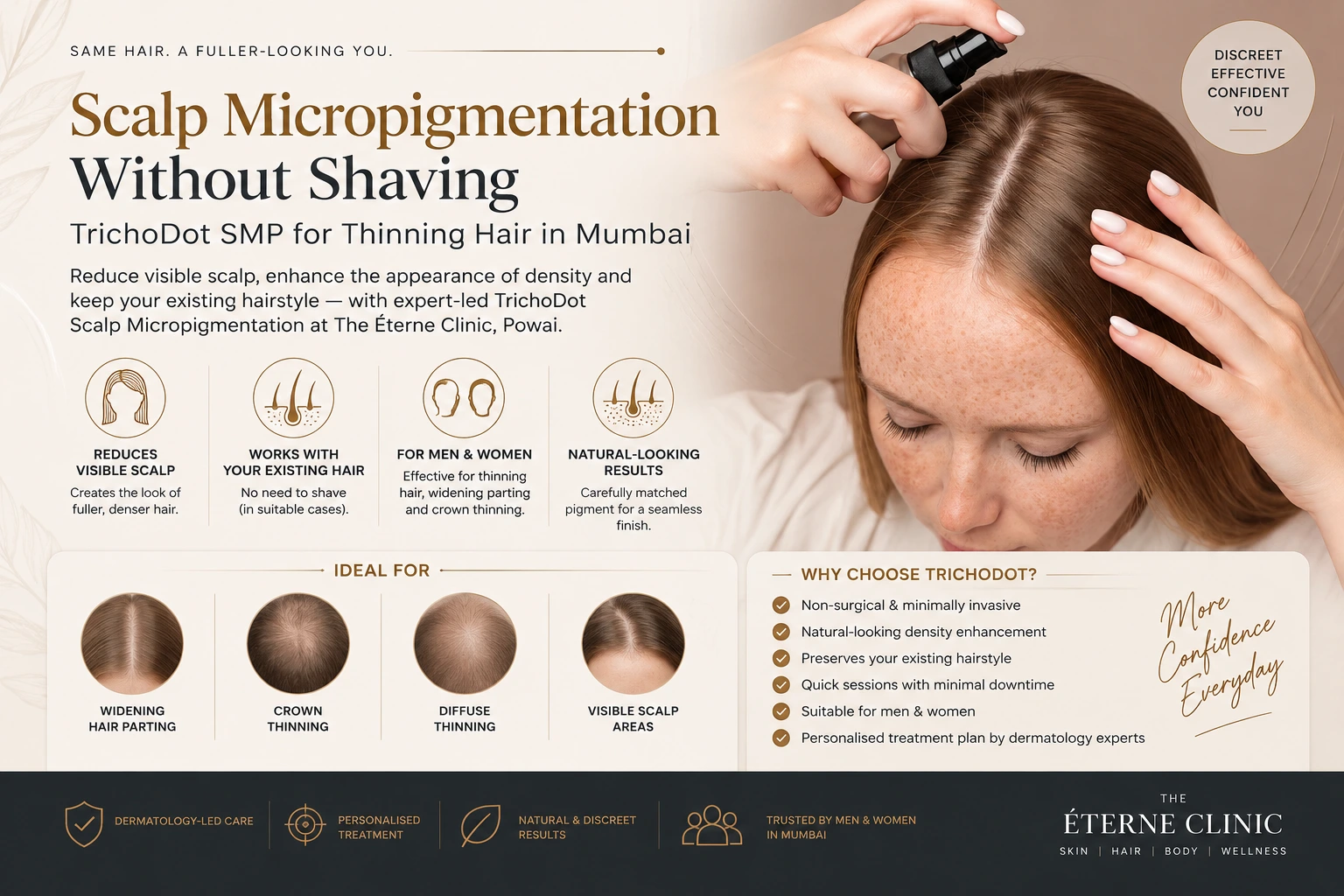
TrichoDot for Thin Hair Without Shaving: Can Scalp Micropigmentation Make Existing Hair Look Denser?
"I don't have a bald head. I have hair—but too much of my scalp is showing."
This is one of the most common concerns we hear from both men and women experiencing early or moderate hair thinning.
And it raises an important question:
Do you actually need more hair, or do you need the hair you already have to look denser?
For years, scalp micropigmentation was associated primarily with men who shaved their heads and wanted to simulate a closely cropped hairline.
Modern density scalp micropigmentation has expanded that concept.
At The Éterne Clinic, Powai, TrichoDot Advanced Scalp Micropigmentation can be used in suitable patients with existing hair to reduce visible scalp and enhance the perception of density—without necessarily creating a shaved-head appearance.
For the right candidate, it can be an entirely different way of thinking about thinning hair.
What Is Scalp Micropigmentation Without Shaving?
Traditional full-scalp SMP is commonly designed to replicate the appearance of very short or freshly shaved follicles.
Density SMP has a different objective.
Instead of trying to create an entire hairstyle from pigment, tiny pigment impressions are placed strategically between existing hairs.
These impressions create a darker visual background beneath the hair.
The result?
The contrast between the hair and scalp is reduced, so the existing hair can appear fuller.
That's the basic principle behind TrichoDot density enhancement.
Why Does Thin Hair Make the Scalp Look So Obvious?
Hair density is partly about numbers—but visually, it's also about contrast.
Imagine dark brown or black hair growing over a lighter scalp.
When density is high, hair covers most of the scalp and relatively little light reflects from the skin underneath.
As hair progressively thins, gaps between the follicles become larger.
More scalp becomes visible.
Under bright lighting, this contrast becomes even more obvious.
This is why patients often say:
"My hair looks fine indoors but thin in sunlight."
"My crown shows under office lights."
"My scalp looks much worse in photographs."
"When my hair is wet, I look almost bald."
TrichoDot targets this hair-to-scalp contrast.
How Does TrichoDot Create Optical Density?
TrichoDot uses carefully selected pigment to create micro-impressions within visible areas of scalp.
These impressions don't grow.
They're not hairs.
But when distributed correctly between existing follicles, they visually break up areas of exposed scalp.
Instead of the eye seeing:
Hair → pale scalp → hair → pale scalp
it sees a more continuous field of colour and shadow.
The result can be a stronger visual impression of density.
Do I Need to Shave My Hair for TrichoDot?
Not necessarily.
In appropriate density-camouflage cases, TrichoDot may be performed while preserving existing hair.
This can be particularly valuable for:
- Women with long hair
- Corporate professionals
- Executives
- Actors and media professionals
- Brides and grooms
- Patients who cannot suddenly change their hairstyle
- Men who don't want a shaved-head look
However, whether treatment can be performed without shaving depends on several factors, including the treatment area, hair density, hair length and access to the scalp.
A consultation is essential.
TrichoDot for Men with Thinning Hair
Not every man with androgenetic alopecia becomes completely bald immediately.
Hair follicles usually miniaturize progressively.
This creates a stage where significant hair remains, but density has decreased enough for the scalp to become visible.
Common areas include:
- Frontal scalp
- Mid-scalp
- Crown
- Temporal regions
For suitable men, TrichoDot can be placed between existing follicles to enhance the appearance of density without requiring the entire scalp to be shaved.
Learn more in our dedicated guide on Scalp Micropigmentation for Men.
TrichoDot for Women with Diffuse Thinning
Female pattern hair loss often creates exactly the type of problem density SMP is designed to address.
Women may retain long hair but develop:
- A widening central part
- Reduced crown density
- Diffuse scalp visibility
- Thinner ponytail volume
The scalp becomes increasingly visible between existing hairs.
Female TrichoDot aims to reduce this contrast while preserving the natural hairstyle.
The objective isn't to create a simulated shaved follicle pattern.
It's to create a subtle background density effect.
Explore our dedicated guide on Scalp Micropigmentation for Women.
TrichoDot for a Widening Hair Part
The central part is particularly important because even relatively modest thinning can make it appear dramatically wider.
Patients often use:
- Hair fibres
- Root sprays
- Scalp powders
- Concealers
- Strategic hairstyles
These can be excellent temporary solutions, but they require repeated application.
TrichoDot provides a longer-lasting camouflage option by placing pigment within the visible scalp rather than coating the hair every day.
TrichoDot for Crown Visibility
The crown is notorious for looking worse under overhead lighting.
Office lights, elevators, shopping centres and photography can make thinning dramatically more visible.
This happens because the scalp reflects light through gaps in the hair.
Carefully planned scalp micropigmentation can reduce this contrast and make the crown appear visually denser.
Is TrichoDot Better Than Hair Fibres?
Not necessarily. They serve different purposes.
Hair fibres provide immediate temporary camouflage and can work beautifully when enough existing hair is present for the fibres to attach to.
However, fibres may:
- Require daily application
- Wash away
- Be affected by sweat or rain
- Transfer onto surfaces
- Require careful styling
TrichoDot is placed within the scalp and therefore provides a longer-lasting visual background.
Some patients may even choose to use both strategically.
TrichoDot vs Hair Transplant for Thinning Hair
This is where patient selection becomes particularly important.
If a patient has genuinely lost follicles and wants actual growing hair, transplantation may be appropriate.
If significant hair remains and the major cosmetic problem is scalp visibility, density SMP may provide another option.
The distinction is:
Hair transplant adds follicles.
TrichoDot reduces scalp contrast.
One creates biological density.
The other creates optical density.
Compare both options in our detailed guide: Hair Transplant vs Scalp Micropigmentation.
Can TrichoDot Be Combined with FAAST Long Hair FUE?
Yes, in selected patients.
This combination can be particularly interesting because each treatment addresses a different limitation.
FAAST Long Hair FUE can restore real follicles.
TrichoDot can reduce visible scalp between existing and transplanted hairs.
For patients with limited donor reserves, this may allow the surgeon to use precious grafts strategically while using optical camouflage to enhance the overall perception of density.
Not every patient needs both, but for appropriate candidates, the two techniques can complement each other.
Why Donor Conservation Matters
A patient's donor area contains a limited number of transplantable follicles.
This supply must potentially last a lifetime.
Aggressively harvesting more and more grafts simply to eliminate every glimpse of scalp can sometimes compromise the donor area.
Modern hair restoration therefore isn't always about asking:
"How many grafts can we extract?"
A better question is:
"How can we create the best visual result while using the donor area intelligently?"
TrichoDot introduces another tool for achieving that goal.
Can TrichoDot Improve a Previous Hair Transplant?
Yes, selected patients may benefit.
Even a successful hair transplant doesn't recreate the original density of an adolescent scalp.
A transplanted area may look excellent in normal conditions but reveal scalp under:
- Strong sunlight
- Wet hair
- Harsh overhead lighting
- High-resolution photographs
Adding more grafts isn't always necessary—or advisable.
In selected cases, TrichoDot can reduce the contrast beneath transplanted hair and enhance the visual density of the existing result.
Can TrichoDot Camouflage Hair Transplant Scars?
Scalp micropigmentation may also be used for selected hair transplant scars.
This can include:
- Linear FUT scars
- Selected FUE donor irregularities
- Certain surgical scalp scars
Pigment can reduce the contrast between scar tissue and the surrounding scalp.
However, scar tissue doesn't behave exactly like normal skin, and pigment retention may be less predictable.
A detailed assessment is required.
Does TrichoDot Stop Hair Loss?
No.
This distinction is critical.
TrichoDot is a cosmetic camouflage treatment.
It does not:
- Block DHT
- Stop follicular miniaturization
- Correct iron deficiency
- Treat thyroid disease
- Reverse hormonal hair loss
- Generate new follicles
If your hair loss is progressive, the underlying condition may continue even after an excellent SMP result.
That's why diagnosis and long-term treatment remain important.
Why Digital Trichoscopy Matters Before Density SMP
Before camouflaging thinning hair, we need to understand what is happening to the follicles.
Digital trichoscopy can help assess:
- Hair density
- Hair shaft diameter
- Miniaturization
- Scalp inflammation
- Follicular distribution
- Progression of hair loss
This is particularly valuable when there is still significant native hair present.
Medical Treatment and TrichoDot Can Work Together
For many patients, the most logical strategy isn't SMP instead of medical treatment.
It is SMP alongside appropriate treatment.
Depending on diagnosis and individual suitability, management may include:
- Minoxidil
- Finasteride for appropriate male patients
- Localized scalp therapies like Combat 98™
- QR678
- PRP
- Regenerative treatments
- Correction of nutritional deficiencies
Medical treatment aims to preserve and improve the biological hair.
TrichoDot addresses its cosmetic appearance.
Will the Pigment Damage Existing Hair?
Density SMP requires careful placement because the treatment is performed among existing follicles.
The procedure should be planned with awareness of follicular anatomy and the pattern of existing hair.
This is another reason why a specialized scalp-focused approach is important, particularly in patients with valuable native hair that needs to be preserved.
What Makes Natural-Looking Density SMP Difficult?
With full shaved-head SMP, the clinician creates a complete visual field of simulated follicles.
Density SMP can actually be more subtle.
Too little pigment may produce inadequate camouflage.
Too much may create an unnatural dark patch.
The key variables include:
- Pigment colour
- Dot size
- Depth
- Spacing
- Density
- Distribution
The scalp shouldn't look "coloured in."
The pigment should disappear visually beneath the hair.
Why More Isn't Always Better
Patients sometimes request maximum darkness in one session.
That isn't necessarily the best strategy.
Natural-looking SMP is generally built progressively.
A conservative first treatment allows us to assess:
- Pigment retention
- Healing
- Colour integration
- Visual density
Additional impressions can then be introduced strategically.
It's easier to add density than to correct excessive pigmentation.
How Many TrichoDot Sessions Are Needed?
There isn't a universal number.
Treatment depends on:
- Size of the thinning area
- Existing hair density
- Skin characteristics
- Degree of scalp contrast
- Pigment retention
- Desired result
Multiple sessions may be used to progressively develop the desired effect.
How Long Does TrichoDot Last?
Scalp micropigmentation is long-lasting, but it can gradually fade.
Fading is influenced by:
- UV exposure
- Skin turnover
- Scalp characteristics
- Lifestyle
- Pigment retention
Touch-ups may therefore be recommended over time.
Daily scalp sun protection where practical can also help protect both the scalp and cosmetic result.
Who Is an Ideal Candidate for No-Shave TrichoDot?
Density-focused TrichoDot may be particularly useful for men and women who:
- Still have significant existing hair
- Have visible scalp between hairs
- Have widening part lines
- Have crown thinning
- Have diffuse reduction in density
- Don't want to shave their hair
- Want a longer-lasting alternative to daily camouflage products
- Want to enhance visual density after transplantation
The key is having enough existing hair for the pigmentation to integrate naturally.
When TrichoDot Should Wait
Not every thinning scalp should immediately be camouflaged.
Patients with:
- Active scalp infection
- Significant dermatitis
- Rapid unexplained shedding
- Active inflammatory scalp disease
- Certain scarring alopecias
may need diagnosis and treatment first.
Camouflage should never interfere with appropriate medical care.
Why Corporate Professionals Are Interested in No-Shave SMP
For a professional working in a corporate environment, a dramatic change in hairstyle can attract unwanted attention.
That's particularly true for senior executives and public-facing professionals.
Density SMP offers an attractive concept:
Improve the appearance of thinning without announcing that you've undergone a hair procedure.
There's no need to suddenly appear with a completely different hairstyle simply because you wanted greater scalp coverage.
This aligns with the growing trend toward undetectable aesthetics—treatments designed to improve appearance without making the intervention obvious.
TrichoDot in Powai: Why Location Matters for Multiple Sessions
Scalp micropigmentation is often performed as a staged treatment rather than a one-time procedure.
Patients may require:
- Initial consultation
- Treatment sessions
- Review
- Future touch-ups
For people living or working around Powai and Hiranandani Gardens, having access to SMP treatment locally can make follow-up more convenient.
At The Éterne Clinic, Powai, Mumbai, TrichoDot forms part of a broader hair restoration program rather than functioning as an isolated cosmetic service.
Why Choose The Éterne Clinic for TrichoDot?
The key question with thinning hair isn't merely:
"Can we hide the scalp?"
We also want to know:
"Why is the scalp becoming visible?"
Our approach can therefore incorporate:
- Dermatological assessment
- Digital trichoscopy
- Medical investigations when required
- Hair-loss stabilization
- Regenerative treatments
- TrichoDot density enhancement
- FAAST Long Hair FUE when surgical restoration is appropriate
This allows us to address both hair biology and hair aesthetics.
The Future Is Optical Density + Biological Density
Modern hair restoration is becoming increasingly sophisticated.
We don't necessarily need one treatment to solve every problem.
Think of it as four layers:
- Medical therapy helps preserve vulnerable follicles.
- Regenerative treatment may support existing hair in selected patients.
- FAAST Hair Transplant restores actual follicles where appropriate.
- TrichoDot enhances the visual impression of density.
The most successful treatment plan may use one—or strategically combine several—depending on the patient.
Final Thoughts
You don't necessarily have to be bald to benefit from scalp micropigmentation.
For many men and women, the real concern isn't absence of hair.
It's too much scalp showing through the hair they still have.
TrichoDot Advanced Scalp Micropigmentation offers a way to address that visual problem without necessarily shaving the existing hairstyle.
By carefully reducing contrast between the hair and scalp, it can create the perception of greater density while allowing patients to retain their natural hair.
The key, however, is correct diagnosis, conservative pigmentation and long-term planning.
At The Éterne Clinic, Powai, Mumbai, TrichoDot is therefore considered part of a 360-degree hair-restoration strategy—not simply a way of putting pigment on the scalp.
Explore our related hair restoration blogs:
- Scalp Micropigmentation in Mumbai: What Is TrichoDot and Who Is It For?
- Scalp Micropigmentation for Men in Mumbai: TrichoDot for Male Pattern Baldness
- Scalp Micropigmentation for Women in Mumbai: TrichoDot for Female Hair Loss
- Hair Transplant vs Scalp Micropigmentation: Which Is Right for You?
- Why FAAST™ is Better Than FUE & FUT Hair Transplants?
- QR678 Therapy for Hair Loss in Mumbai: Growth Factor Treatment for Hair Regrowth
- Exosome Therapy in Mumbai – Gold Standard for Hair & Skin
- Combat 98™ Hair Loss Treatment in Mumbai: Localized DHT Blocking
Medical & Legal Disclaimer
This article is purely for educational and informational purposes and does not constitute medical advice, diagnosis, treatment recommendation or a guarantee of results. TrichoDot Scalp Micropigmentation is a cosmetic camouflage procedure and does not create new follicles, biologically regrow hair, increase actual follicular density or stop progressive hair loss. No-shave/density SMP is not suitable for every patient, and the ability to retain existing hair during treatment depends on individual hair density, scalp access, diagnosis and treatment area. Results, pigment retention, number of sessions, longevity, downtime and potential risks vary between individuals. Hair loss should be appropriately evaluated before cosmetic camouflage, particularly when it is rapid, unexplained or associated with scalp disease. Consultation with a qualified healthcare professional is essential before undergoing any medical, regenerative, micropigmentation or surgical hair-restoration procedure.