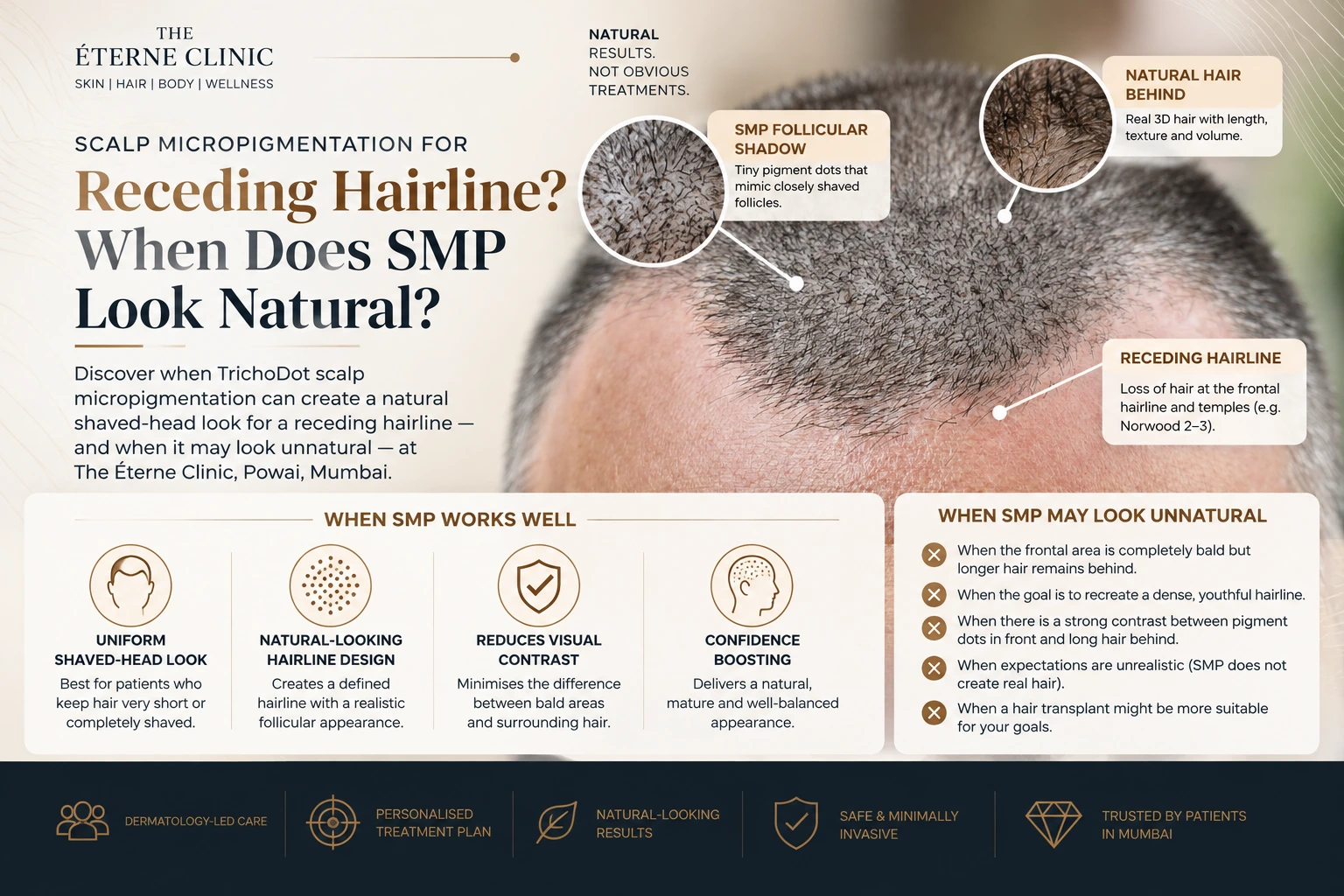
Scalp Micropigmentation for a Receding Hairline: When Does SMP Look Natural—and When Should You Avoid It?
Scalp micropigmentation can produce an impressive cosmetic effect in the right patient.
But here's something patients aren't always told:
SMP isn't a good solution for every receding hairline.
Imagine a man with Norwood Grade 3 hair loss. His frontal hairline and temples are completely bald, but several centimetres behind this empty zone, he still has normal-length hair.
If pigment dots are simply placed across that completely bald frontal area, we create a potential visual mismatch.
At the front are flat, two-dimensional pigment impressions.
Immediately behind them are real, three-dimensional hairs with length, texture, movement and volume.
The difference can become obvious—and the result may look unnatural.
At The Éterne Clinic, Powai, Mumbai, we believe scalp micropigmentation should be recommended according to what it can realistically achieve, rather than trying to use it for every form of baldness.
So, when does TrichoDot Advanced Scalp Micropigmentation make sense?
Let's understand the difference.
Why SMP Doesn't Actually Replace Missing Hair
Scalp micropigmentation doesn't create hair.
It creates tiny pigment impressions intended to mimic the visual shadow of a very closely shaved follicle.
That's an important distinction.
When a person shaves their head very closely, thousands of follicles remain visible as tiny dark impressions against the scalp.
SMP can recreate or enhance this visual effect.
But a pigment dot cannot reproduce:
- Hair length
- Hair shaft thickness
- Movement
- Texture
- Projection above the skin
- Styling volume
That's why SMP works best when its optical effect matches the hairstyle around it.
The Problem With Putting SMP Into a Completely Bald Frontal Area
Consider a man with a receded hairline.
The first few centimetres of his frontal scalp may be completely hairless.
Behind that area, however, he may still have relatively dense hair that he wears several centimetres long.
If we create SMP dots in the bald area, the front may resemble a shaved scalp, while the region immediately behind contains longer hair.
This can produce a visible transition:
Pigment dots in front → actual longer hair behind.
Rather than restoring the hairline, the pigmentation can draw attention to the fact that there isn't actual hair in the frontal zone.
For this reason, we generally wouldn't consider SMP alone an ideal substitute for missing frontal hair when a patient wants to retain meaningful hair length behind it.
Norwood Grade 2, 3 and 4: Why Hairstyle Matters
This distinction becomes particularly relevant in men with Norwood Grade 2, Grade 3 or Grade 4 hair loss.
These men may have:
- Temporal recession
- An M-shaped hairline
- Completely bald frontal corners
- Frontal hairline loss
- Preserved hair farther behind
If they intend to continue wearing the remaining hair longer, simply filling the empty frontal scalp with pigment may not create a convincing hairline.
There's simply no real hair shaft in that empty zone.
Pigment cannot substitute for three-dimensional hair when it's sitting immediately beside longer biological hair.
So, Is SMP Bad for a Receding Hairline?
Not necessarily.
The answer changes completely if the patient wants a uniformly shaved or buzz-cut hairstyle.
This is where scalp micropigmentation can become a very interesting option.
If the patient's remaining biological hair is shaved very short, both the natural follicles and SMP impressions can exist within a similar visual plane.
Instead of:
dots in front + long hair behind
we now have:
simulated follicular shadow in front + closely shaved follicular shadow behind.
Visually, these can integrate much more naturally.
The Shaved-Head Look: Bald by Choice, Not Balding
There's an important aesthetic difference between looking bald because you've lost hair and sporting a deliberately shaved head.
Think of the familiar action-film aesthetic associated with a completely shaved scalp: strong, clean and intentional. Rather than attempting to disguise every sign of baldness with longer hair, the person embraces the buzzed or shaved look.
It's popular among:
- Bikers
- Fitness enthusiasts
- Athletes
- Corporate professionals
- Men who prefer low-maintenance grooming
- Men with advanced male pattern baldness
The aesthetic message changes from:
"I'm losing my hair."
to:
"I choose to shave my head."
That's where SMP can be powerful.
How TrichoDot Creates the Shaved-Follicle Effect
When natural hair is shaved extremely short, you don't primarily see the hair shaft.
You see thousands of tiny follicular shadows.
TrichoDot aims to recreate this appearance in areas where follicles have been lost.
The treatment can help create the visual impression of:
- A defined but shaved hairline
- Follicular shadow across bald scalp
- More uniform scalp coverage
- Reduced contrast between bald and hair-bearing areas
The key requirement is consistency of hairstyle.
The remaining biological hair generally needs to be maintained sufficiently short for the pigment and natural follicular shadow to visually integrate.
SMP Isn't a Way to Have a Pigmented Hairline With Long Hair Behind It
This expectation needs to be addressed clearly during consultation.
A patient may ask:
"Can you just make dots where my old hairline used to be while I keep the rest of my hair long?"
For a completely hairless frontal zone, our answer would generally be:
That may not produce a natural result.
SMP creates an illusion of extremely short hair.
It doesn't create an illusion of long hair.
If longer hair begins immediately behind a pigmented bald region, the difference in height and texture can expose the illusion.
In such a patient, an actual hair transplant may be more appropriate if the goal is to restore a frontal hairline while retaining longer hairstyles.
Hair Transplant vs TrichoDot for a Receding Hairline
The decision becomes much easier when we ask one question:
How do you want to wear your hair?
If You Want Longer Hair
A hair transplant may be the more logical option in an appropriate surgical candidate.
Transplanted follicles produce actual hair.
They can:
- Grow
- Be cut
- Be combed
- Have texture
- Move naturally
- Blend with longer hair behind them
For men with Norwood Grade 2–4 recession who have adequate donor hair, a carefully planned transplant may therefore be preferable when restoring actual frontal hair is the goal.
Learn more about FAAST Long Hair FUE.
If You Want a Shaved or Buzzed Look
TrichoDot can become an attractive option.
The existing hair is kept very short so its follicular shadow blends with the pigmentation.
The objective isn't to pretend the patient has long hair.
It's to create the appearance of a fuller scalp that has intentionally been shaved.
That distinction is everything.
Why Hairline Design Still Matters in Shaved-Look SMP
Even when a patient is an excellent SMP candidate, the hairline shouldn't look painted on.
An unnatural SMP hairline can be:
- Too low
- Too straight
- Too symmetrical
- Too dark
- Too sharply defined
- Too dense
A natural adult male hairline normally contains irregularity and subtle asymmetry.
TrichoDot should respect those characteristics.
The goal isn't to draw a border around the forehead.
It's to recreate believable follicular shadow.
A Shaved Hairline Should Still Be Age Appropriate
A 45-year-old man doesn't necessarily need the hairline he had at 16.
Trying to create an extremely low juvenile hairline may make SMP more obvious rather than more attractive.
Hairline planning should consider:
- Age
- Facial proportions
- Forehead dimensions
- Head shape
- Existing hair
- Degree of baldness
- Future ageing
A slightly mature hairline often creates a much more believable shaved-head result.
Where TrichoDot Can Work Well Without Shaving
There's an important exception to everything we've discussed.
SMP doesn't always require shaving.
If a patient has thinning hair rather than a completely hairless area, TrichoDot can potentially be placed between existing hairs.
Here, we're not trying to create new hair where none exists.
We're using pigment to reduce visible scalp beneath existing hair.
This is called density SMP.
It can be useful in selected men and women with:
- Diffuse thinning
- Crown show-through
- Widening parting
- Reduced density after transplantation
That's fundamentally different from placing dots across an empty frontal scalp.
Learn more in our guide on Scalp Micropigmentation Without Shaving.
Empty Scalp and Thin Scalp Are Two Different Problems
This is one of the most important concepts for patients to understand.
Thin Area With Existing Hair
There are real hairs throughout the area.
TrichoDot can reduce scalp contrast between them.
Potential objective: greater visual density.
Completely Bald Area With Longer Hair Behind
There are no hair shafts in the treated area.
Pigment can only simulate shaved follicular shadow.
Potential problem: obvious 2D pigment beside 3D longer hair.
This distinction should guide patient selection.
What About Crown Baldness?
The same principle applies to the crown.
If the crown is completely bald but surrounding hair is worn long, pigmentation may not seamlessly reproduce the appearance of actual hair.
However, if there is diffuse thinning with substantial existing hair, density SMP may help reduce scalp visibility.
Alternatively, if the patient chooses a uniform buzzed hairstyle, broader SMP may be considered as part of that aesthetic.
SMP for Advanced Baldness
Interestingly, SMP may sometimes make more aesthetic sense for advanced baldness than for a small isolated bald frontal patch.
Why?
Because a patient with extensive baldness may decide to shave the remaining hair completely short.
TrichoDot can then create a relatively uniform follicular-shadow effect across the scalp.
Instead of attempting to recreate long hair, we're deliberately creating the appearance of a closely shaved full scalp.
For the right patient, that's a much more coherent visual result.
TrichoDot for Bikers, Athletes and Men Who Love the Buzzed Look
Some men simply prefer extremely short hair.
For them, SMP isn't necessarily about hiding hair loss.
It's about improving the aesthetics of a hairstyle they already like.
A well-designed shaved-head SMP effect can potentially:
- Re-establish the visual frame of the face
- Reduce contrast between bald and hair-bearing areas
- Create a more uniform scalp appearance
- Make advanced hair loss less conspicuous
And there's no daily styling.
For someone already comfortable keeping the scalp closely shaved, this can be a practical option.
Can SMP Be Combined With a Hair Transplant?
Yes, but again, the treatment has to make visual sense.
For patients with transplanted hair and residual scalp visibility, TrichoDot can sometimes be used between actual follicles to enhance optical density.
This is very different from trying to replace an entire bald frontal zone with pigment while keeping the transplanted or native hair behind it long.
At The Éterne Clinic, we think about this as:
FAAST Hair Transplant = biological density
TrichoDot = optical density
They can complement each other when each is used for the problem it actually solves.
Compare both options in our guide: Hair Transplant vs Scalp Micropigmentation.
Why Donor Hair Availability Can Influence the Decision
Not every patient with extensive baldness has enough donor hair to reconstruct everything surgically.
A patient with advanced male pattern baldness may have a very large recipient area but limited donor reserves.
If he wants long hair, transplantation may offer only partial coverage.
If he's comfortable with a shaved aesthetic, TrichoDot may offer another route that doesn't consume donor grafts.
The correct choice therefore depends on:
- Norwood grade
- Donor density
- Hair calibre
- Age
- Future hair-loss risk
- Desired hairstyle
- Patient expectations
Does SMP Stop Hair Loss?
No.
Whether used for a shaved-head effect or density camouflage, TrichoDot doesn't treat androgenetic alopecia.
It doesn't block DHT and doesn't stop follicular miniaturization.
Patients with progressive hair loss should still undergo appropriate dermatological evaluation.
Where suitable, medical management may be recommended to preserve remaining biological hair.
Learn more about Finasteride and Combat 98™.
Why Consultation Before SMP Is So Important
The question shouldn't simply be:
"Can pigment be placed here?"
Technically, pigment can be placed in many areas.
The better question is:
"Will pigment placed here create a believable result with the hairstyle this patient wants?"
That's a very different standard.
At The Éterne Clinic, Powai, TrichoDot planning considers the complete appearance rather than simply filling bald areas.
Who May Be a Good Candidate for TrichoDot?
TrichoDot may be particularly worth considering for:
- Men who prefer a completely shaved or very closely buzzed hairstyle
- Men with extensive baldness who want a uniform shaved-head appearance
- Patients with thinning—but not completely bald—areas where scalp contrast can be reduced
- Women with suitable diffuse thinning or widening parting
- Selected patients with residual scalp visibility after transplantation
- Selected FUT or FUE scar-camouflage cases
Explore our dedicated guides for Scalp Micropigmentation for Men and Scalp Micropigmentation for Women.
Who May Not Be an Ideal Candidate?
SMP alone may not be the most natural choice for a man who:
- Has a completely hairless frontal zone
- Has longer, dense hair immediately behind it
- Wants to continue wearing that hair long
- Expects pigment to look like actual long hair
- Wants three-dimensional frontal density
For an appropriate candidate with adequate donor reserves, hair transplantation may make considerably more aesthetic sense in this situation.
TrichoDot SMP in Powai, Mumbai
For patients searching for scalp micropigmentation in Mumbai, SMP in Powai or scalp micropigmentation near Hiranandani Gardens, the most important part of consultation is determining whether SMP actually suits the desired hairstyle.
At The Éterne Clinic, Powai, Mumbai, patients can be assessed for multiple options, including:
- Medical hair-loss management
- TrichoDot density SMP
- Full shaved-look TrichoDot
- Regenerative treatments like QR678
- FAAST Long Hair FUE
- Combination hair-restoration strategies
That allows us to recommend the technique according to the patient's hair rather than trying to fit every patient into the same procedure.
The Takeaway: SMP Should Match the Hairstyle
Scalp micropigmentation can create a powerful visual transformation—but only when its limitations are respected.
For a man with a completely bald frontal zone and longer hair behind it, simply placing pigment dots where the old hairline used to be may look unnatural.
Pigment is two-dimensional. Hair is three-dimensional.
You cannot reliably replace centimetres of missing hair length with dots.
But change the aesthetic objective to a uniformly shaved or closely buzzed head, and SMP becomes a very different proposition.
Now, the pigment isn't trying to imitate long hair.
It's imitating the follicular shadow of intentionally shaved hair.
That's where TrichoDot can make aesthetic sense.
For patients who want to keep longer hair and genuinely restore a receding Norwood Grade 2, 3 or 4 hairline, an appropriately planned hair transplant may be the better solution.
For patients who love the clean-shaven, biker-inspired, athletic buzzed aesthetic, TrichoDot can help turn the appearance of progressive baldness into the appearance of an intentional shaved hairstyle.
And that distinction is precisely what responsible scalp micropigmentation planning should explain.
Explore our related hair restoration blogs:
- Scalp Micropigmentation in Mumbai: What Is TrichoDot and Who Is It For?
- Scalp Micropigmentation for Men in Mumbai: TrichoDot for Male Pattern Baldness
- Scalp Micropigmentation for Women in Mumbai: TrichoDot for Female Hair Loss
- Scalp Micropigmentation Without Shaving in Mumbai: TrichoDot SMP for Thinning Hair
- Scalp Micropigmentation Cost in Mumbai: TrichoDot SMP Price, Sessions & Results
- How Long Does Scalp Micropigmentation Last? TrichoDot SMP Results & Maintenance
- Does Scalp Micropigmentation Look Fake? Natural TrichoDot SMP in Mumbai
- Hair Transplant Scar Micropigmentation: Can TrichoDot Camouflage FUT and FUE Scars?
- Widening Hair Part in Women? How TrichoDot SMP Can Camouflage Female Pattern Hair Loss
- Hair Transplant vs Scalp Micropigmentation: Which Is Right for You?
- Why FAAST™ is Better Than FUE & FUT Hair Transplants?
Medical & Legal Disclaimer
This article is purely for educational and informational purposes. It does not constitute medical advice, diagnosis, treatment recommendation or a guarantee of results. TrichoDot Scalp Micropigmentation is a cosmetic camouflage procedure and does not create new hair follicles, produce actual hair shafts, biologically regrow hair or stop progressive hair loss. The suitability and natural appearance of SMP depend significantly on the pattern of hair loss, presence or absence of native hair, hairstyle, skin characteristics, pigment response and individual expectations. In completely hairless areas adjacent to longer hair, SMP may create an aesthetically unsuitable contrast and should not automatically be considered a substitute for hair transplantation. Results, pigment retention, fading, number of sessions, longevity, downtime and potential risks vary between individuals. Patients should undergo appropriate clinical assessment and consult a qualified healthcare professional before undergoing medical, regenerative, micropigmentation or surgical hair-restoration treatment.