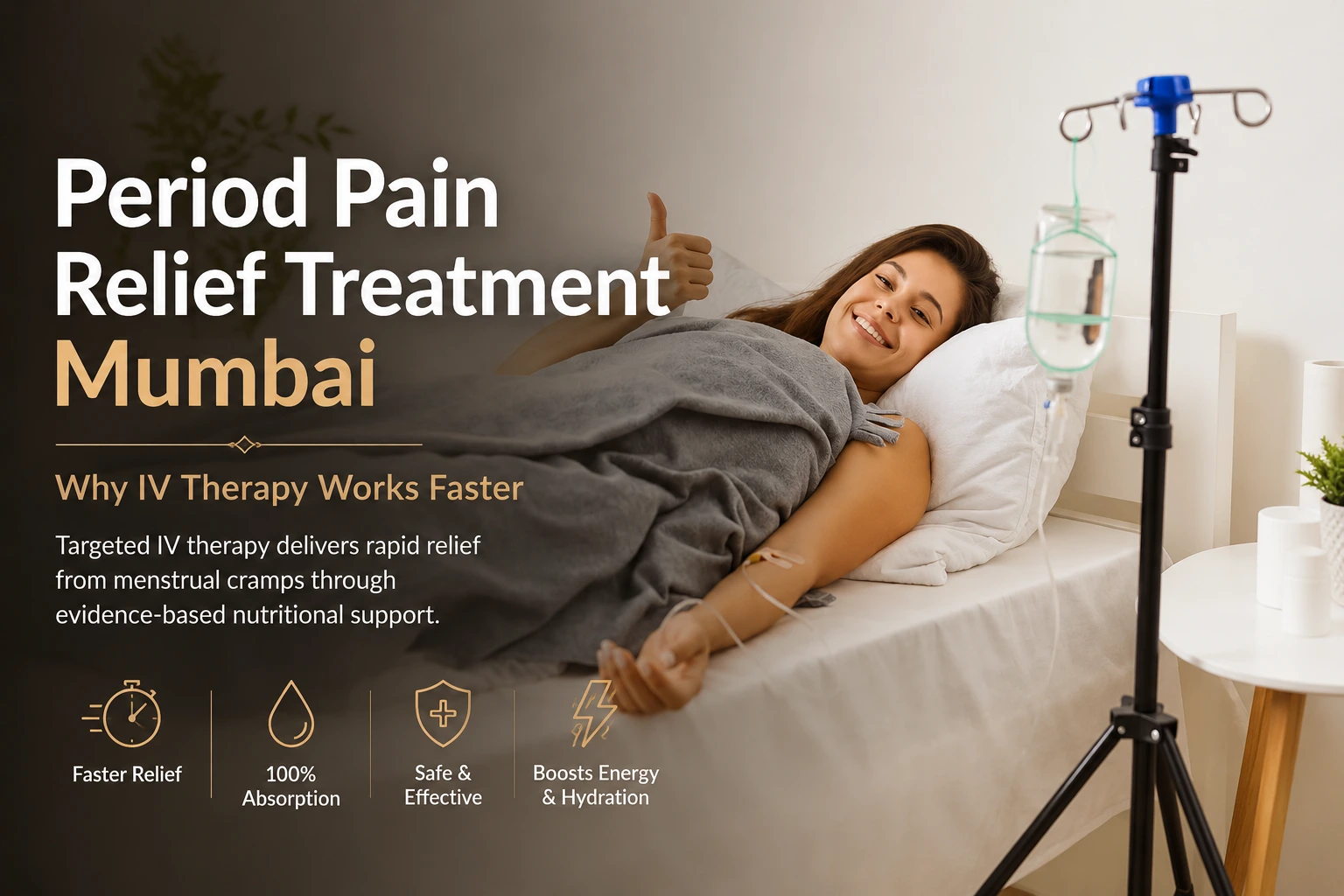
Period Pain Relief Treatment Mumbai: Why IV Therapy Works Faster
Menstrual cramps can be severely debilitating, affecting your ability to work, exercise, and enjoy daily activities. At Éterne Clinic in Powai, we're pioneering a faster, more effective approach to dysmenorrhea management through evidence-based IV therapy that delivers relief when you need it most.
Understanding Dysmenorrhea: When Period Pain Becomes Debilitating
Dysmenorrhea—the medical term for menstrual cramps—affects approximately 50-90% of menstruating individuals globally. While some experience mild discomfort, others face severe, incapacitating pain that significantly impacts their quality of life.
The mechanism behind period pain is well-established in scientific literature. During menstruation, the uterus contracts to shed its lining. These contractions are triggered by prostaglandins—hormone-like substances that increase in concentration during your cycle. Higher prostaglandin levels lead to stronger uterine contractions, increased blood vessel constriction, and reduced oxygen supply to the uterus. This cascade of physiological events is what causes the characteristic cramping, heaviness, and throbbing pain many experience.
Dysmenorrhea falls into two categories:
- Primary dysmenorrhea: Pain without an underlying gynecological condition; typically appears within 1-2 years of menstruation beginning
- Secondary dysmenorrhea: Pain caused by underlying conditions like endometriosis, fibroids, or pelvic inflammatory disease
Understanding which type you experience is crucial for developing an effective treatment strategy. This is why a proper assessment at your initial consultation is essential.
Why Traditional Painkillers May Not Be Enough
Over-the-counter NSAIDs (non-steroidal anti-inflammatory drugs) like ibuprofen and naproxen are often the first line of defense against menstrual pain. They work by inhibiting prostaglandin production, which is why they're considered effective for dysmenorrhea management.
However, traditional painkillers come with notable limitations:
- Delayed onset: Oral medications typically require 45 minutes to 2 hours to reach therapeutic levels in your bloodstream
- Digestive absorption issues: If you have a sensitive stomach or digestive challenges, medication absorption becomes unpredictable
- Limited duration: Most oral painkillers last 4-6 hours, requiring repeated dosing throughout the day
- Gastrointestinal side effects: Regular NSAID use can cause stomach upset, nausea, and in some cases, gastrointestinal complications with long-term use
- Individual variation:Not everyone responds equally to the same medication or dosage
- Additional symptoms:Beyond pain, period pain often involves fatigue, nausea, and electrolyte imbalances that oral painkillers alone don't address
For many patients in Mumbai and Powai who juggle demanding professional schedules, waiting hours for pain relief simply isn't practical. This is where IV therapy offers a distinctly different approach.
The Science Behind IV Therapy for Menstrual Cramps Relief
Intravenous (IV) therapy delivers nutrients and therapeutic compounds directly into your bloodstream, bypassing the digestive system entirely. This method offers several scientific advantages for dysmenorrhea management.
When you consume medication orally, it must first be broken down by stomach acid, absorbed through the intestinal walls, processed by the liver, and then distributed throughout your body. This process—called "first-pass metabolism"—not only takes time but also reduces the effective concentration of the medication that actually reaches your target tissues.
IV therapy achieves 100% bioavailability, meaning the entire dose enters your circulation immediately and becomes available for therapeutic action. For menstrual pain relief, this translates to:
- Rapid anti-inflammatory response: Anti-inflammatory compounds reach affected tissues within minutes rather than hours
- Immediate symptom relief: Patients typically report pain reduction much faster than with oral medications
- Hydration support: IV fluids address the dehydration that often accompanies heavy menstrual flow, which can worsen cramping and fatigue
- Electrolyte balance: Targeted mineral replacement helps stabilize muscle function and reduce the severity of uterine contractions
- Sustained relief:: The infusion provides steady-state therapeutic levels throughout the session, avoiding the peaks and valleys of oral medication effectiveness
The formulation we use at Éterne Clinic is specifically designed to address the physiological mechanisms of period pain, not just provide general pain relief.
What's in the MOJO Period Pain Relief Drip?
Our proprietary MOJO Period Pain Relief Drip is a precision formulation developed to target the root physiological causes of dysmenorrhea. Rather than a one-size-fits-all solution, each component is evidence-based and purposefully included.
The drip typically includes:
- Rapid anti-inflammatory response: Anti-inflammatory compounds reach affected tissues within minutes rather than hours
- Immediate symptom relief: Patients typically report pain reduction much faster than with oral medications
- Hydration support: IV fluids address the dehydration that often accompanies heavy menstrual flow, which can worsen cramping and fatigue
- Electrolyte balance: Targeted mineral replacement helps stabilize muscle function and reduce the severity of uterine contractions
- Sustained relief:: The infusion provides steady-state therapeutic levels throughout the session, avoiding the peaks and valleys of oral medication effectiveness
Your formulation may be customized based on your symptom profile, medical history, and specific needs identified during your consultation.
IV Therapy vs Oral Medications: Bioavailability and Speed
The difference between IV therapy and oral medications becomes most apparent when you need fast relief. Here's how they compare:
| Aspect | Oral Medications | IV Therapy | |--------|------------------|-----------| | Onset time | 45 minutes–2 hours | 5–15 minutes | | Bioavailability | 20-70% (depending on medication and individual factors) | 100% | | Peak effectiveness | 1–2 hours after ingestion | Within 15–30 minutes | | Duration | 4–6 hours | 1–2 hours of infusion, with effects lasting 4–8 hours | | GI side effects | Common | Minimal to none | | Dosing consistency | Variable absorption | Consistent delivery |
For someone experiencing severe menstrual cramps during a work meeting or important event, waiting 2 hours for oral medication to take effect simply isn't viable. IV therapy's rapid onset makes it an ideal solution for time-sensitive situations.
Who Benefits Most from Period Pain Relief Treatment?
While dysmenorrhea affects many, certain individuals see particularly significant benefits from IV therapy:
- Individuals with severe primary dysmenorrhea who don't achieve adequate relief from standard oral medications
- Those with sensitive digestive systems who experience NSAID-related nausea or GI complications
- Women with heavy periods experiencing significant fatigue and electrolyte depletion
- Professionals with demanding schedules who need rapid, reliable pain relief without the waiting period
- Athletes and active individuals whose training or competition schedules conflict with their menstrual cycle
- People with comorbid conditions like migraines or nausea that compound menstrual pain symptoms
- Those seeking complementary treatment to enhance their existing pain management strategy
It's important to note that IV therapy is most appropriate for primary dysmenorrhea. If you have secondary dysmenorrhea related to endometriosis, fibroids, or other conditions, treating the underlying cause remains essential. IV therapy can be part of your comprehensive management strategy, but not a substitute for addressing root conditions.
What to Expect During Your IV Therapy Session at Éterne Clinic
Understanding what happens during your visit helps you feel prepared and confident. Here's the typical IV therapy experience at our Powai clinic:
Pre-treatment consultation (15-20 minutes) Our medical professionals conduct a thorough health assessment, discuss your symptom severity, review your medical history, and ensure IV therapy is appropriate for you. We'll also explain the procedure and answer any concerns.
IV placement (5 minutes) Our trained medical staff will identify an appropriate vein, typically in your arm, and place a thin IV catheter. Most patients describe this as minimally uncomfortable.
Infusion (45-60 minutes) You'll relax in a comfortable, private treatment room while the MOJO drip infuses. Many patients read, work on their laptops, or simply rest. The actual infusion is painless—you'll only feel the fluids entering your vein, which some describe as cooling or soothing.
Monitoring (throughout session) Our medical team monitors your comfort and vital signs throughout the infusion. This ensures safety and allows us to adjust the infusion rate if needed.
Post-infusion recovery (10-15 minutes) After the infusion completes, we'll remove the IV catheter and provide aftercare instructions. Most patients feel comfortable returning to normal activities immediately, though staying hydrated is encouraged.
Expected results Most patients report noticeable pain relief within 30-60 minutes of starting the infusion. Full symptom relief—including reduced fatigue and nausea—may take several hours as the nutrients become fully distributed throughout your body.
Frequently Asked Questions (FAQs)
If period pain is impacting your quality of life, schedule a consultation at Éterne Clinic, Powai to explore whether our evidence-based IV therapy approach is right for you.
The information provided in this article is for educational purposes only and does not constitute medical advice. Individual results may vary. IV therapy for period pain relief should be considered as part of a comprehensive treatment approach and is not a cure for underlying gynecological conditions. A thorough medical assessment is required before treatment. Please consult with our qualified medical professionals at Éterne Clinic to determine if this treatment is appropriate for your specific health needs and medical history. This treatment is not suitable for everyone and contraindications may apply.