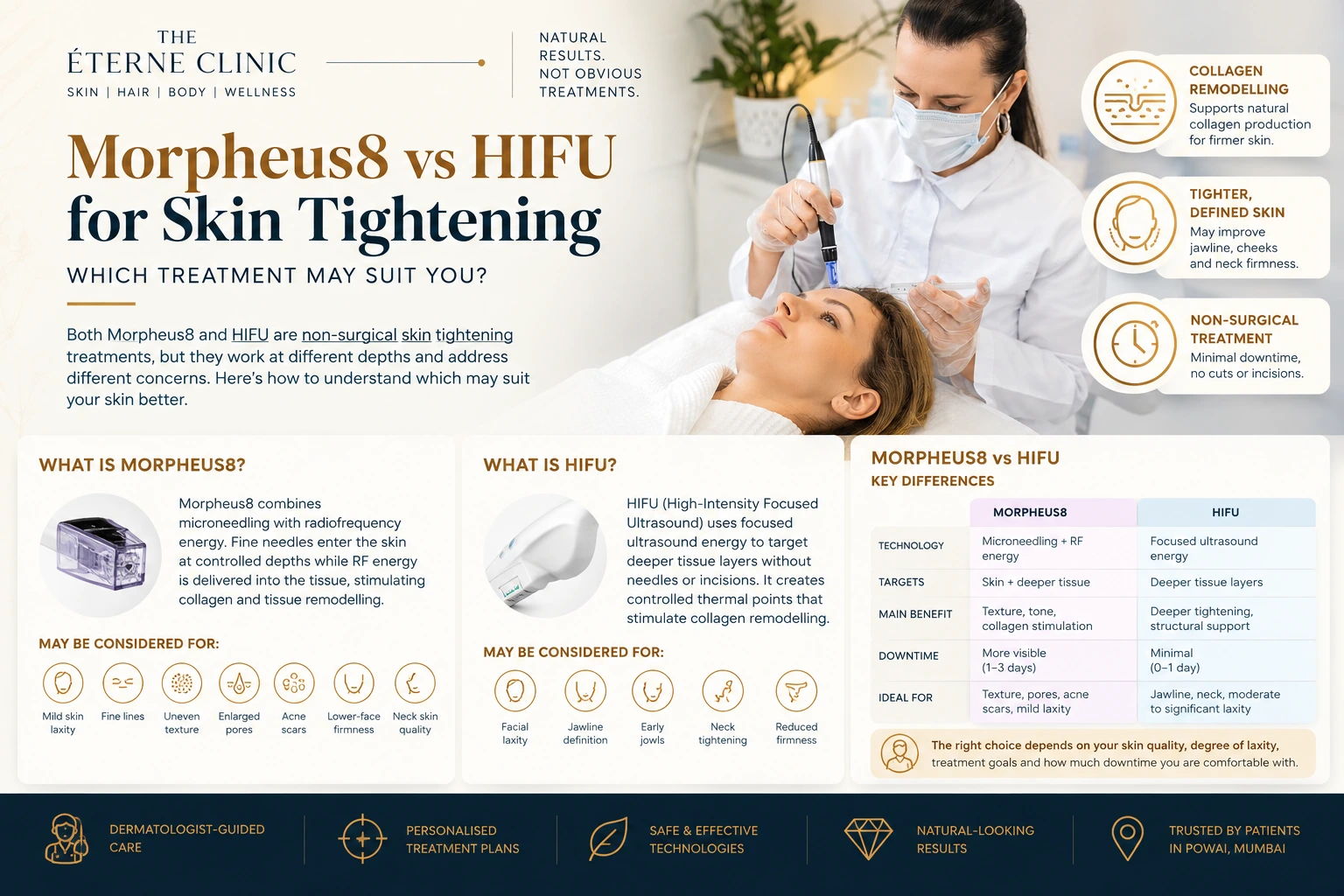
Morpheus8 vs HIFU for Skin Tightening: Which Treatment May Suit You?
Loose skin around the jawline, mild jowls, early neck laxity, and changes in facial firmness are common concerns as collagen production gradually declines with age.
Two popular non-surgical options are Morpheus8 RF microneedling and HIFU skin tightening.
Both can support collagen remodelling, but they do not work in exactly the same way. Choosing between them depends on your skin quality, degree of laxity, treatment goals, and how much downtime you are comfortable with.
At The Éterne Clinic in Hiranandani Gardens, Powai, Mumbai, skin tightening is planned under the guidance of Dr. Ajara Sayyad, Board-Certified Dermatologist, Regenerative Medicine Specialist, and Medical Director of The Éterne Clinic.
What Is Morpheus8?
Morpheus8 combines microneedling with radiofrequency energy.
During treatment, fine needles enter the skin at controlled depths while RF energy is delivered into selected tissue layers. This creates a controlled thermal response that may stimulate collagen and tissue remodelling.
Morpheus8 may be considered for:
- Mild skin laxity
- Fine lines
- Uneven texture
- Enlarged pores
- Acne scars
- Lower-face firmness
- Neck skin quality
Because the treatment combines needling and radiofrequency, it may be especially useful when tightening and texture improvement are both treatment goals.
What Is HIFU?
HIFU stands for High-Intensity Focused Ultrasound.
It uses focused ultrasound energy to target deeper tissue layers beneath the skin without needles or surgical incisions.
The energy creates controlled thermal points that may stimulate collagen remodelling over time.
HIFU for skin tightening is often considered for:
- Mild to moderate facial laxity
- Jawline definition
- Early jowls
- Neck tightening
- Reduced facial firmness
It is generally selected when deeper tissue support is a bigger concern than surface texture.
Morpheus8 vs HIFU: What Is the Main Difference?
The main difference lies in how the energy is delivered and which tissue levels are targeted.
Morpheus8 uses microneedles combined with radiofrequency energy. This allows treatment of both skin texture and deeper tissue.
HIFU delivers focused ultrasound energy without breaking the skin surface and is often aimed at deeper structural tightening.
So, when comparing Morpheus8 vs HIFU, the better choice depends on what you are trying to improve.
If texture, acne scarring, pores, and mild laxity are all concerns, Morpheus8 may be more appropriate.
If the primary issue is deeper laxity around the jawline or neck, HIFU may be considered.
Which Treatment Has More Downtime?
Morpheus8 usually involves more visible short-term recovery because microneedles enter the skin.
Temporary effects can include:
- Redness
- Mild swelling
- Sensitivity
- Tiny pinpoint marks
- Temporary dryness or roughness
HIFU generally has less visible downtime. Some patients may experience temporary tenderness, swelling, or sensitivity.
Recovery varies depending on treatment intensity, skin type, and individual response.
Which Treatment Gives Faster Results?
Neither treatment should be promoted as an instant lift.
Both depend partly on the body’s collagen-remodelling process, which develops gradually.
Some patients may notice early changes within weeks, but more meaningful improvement can continue over several months.
Dr. Ajara Sayyad advises patients to focus on gradual improvement rather than expecting dramatic overnight changes.
Can Morpheus8 and HIFU Be Combined?
In selected patients, they may be used at different stages of a broader treatment plan.
However, combining treatments is not automatically better.
If one technology adequately addresses the main concern, adding another procedure may be unnecessary.
At The Éterne Clinic, treatment decisions are based on anatomy, skin quality, degree of laxity, previous procedures, and individual goals.
Who Is a Good Candidate?
Both treatments are generally considered for adults with mild to moderate laxity who want a non-surgical approach.
Suitability depends on:
- Skin thickness
- Degree of looseness
- Facial anatomy
- Medical history
- Previous aesthetic treatments
- Skin sensitivity
- Expectations
Patients with significant loose skin may not achieve their desired outcome with non-surgical tightening alone.
In those situations, the limitations of treatment should be explained clearly.
Why a Dermatologist Assessment Matters
What appears to be “loose skin” is not always purely a skin problem.
Changes in facial appearance can result from a combination of collagen loss, changes in facial fat, bone structure, muscle activity, and skin quality.
This is why choosing between Morpheus8 in Mumbai and HIFU in Powai should begin with a proper assessment rather than simply selecting a machine.
At The Éterne Clinic, Dr. Ajara Sayyad evaluates the face and neck as a whole before recommending a treatment strategy.
Final Word
Morpheus8 and HIFU can both support non-surgical skin tightening, but they serve different purposes.
Morpheus8 may be better suited to patients who want improvement in both texture and firmness, while HIFU may be more appropriate when deeper tissue tightening is the main objective.
The right choice depends on your skin, anatomy, goals, and tolerance for downtime.
At The Éterne Clinic in Powai, Mumbai, the focus is on selecting the most suitable treatment rather than recommending the most popular one.
Explore our related skin and aesthetic blogs:
- Thread Lift in Mumbai: Natural Face Lifting Without Surgery
- Face Exosome Therapy in Mumbai: Beyond Vampire Facial PRP for Skin Regeneration
- Top 4 Acne Scar Treatments by Dermatologists
- PRP for Face & Skin in Powai
Disclaimer
This article is intended for general educational purposes only and does not replace medical consultation, diagnosis, or treatment. Suitability, recovery, number of sessions, and outcomes vary depending on skin type, age, genetics, medical history, treatment parameters, lifestyle, and adherence to post-care. Individual assessment by a qualified medical professional is recommended before undergoing any aesthetic procedure.