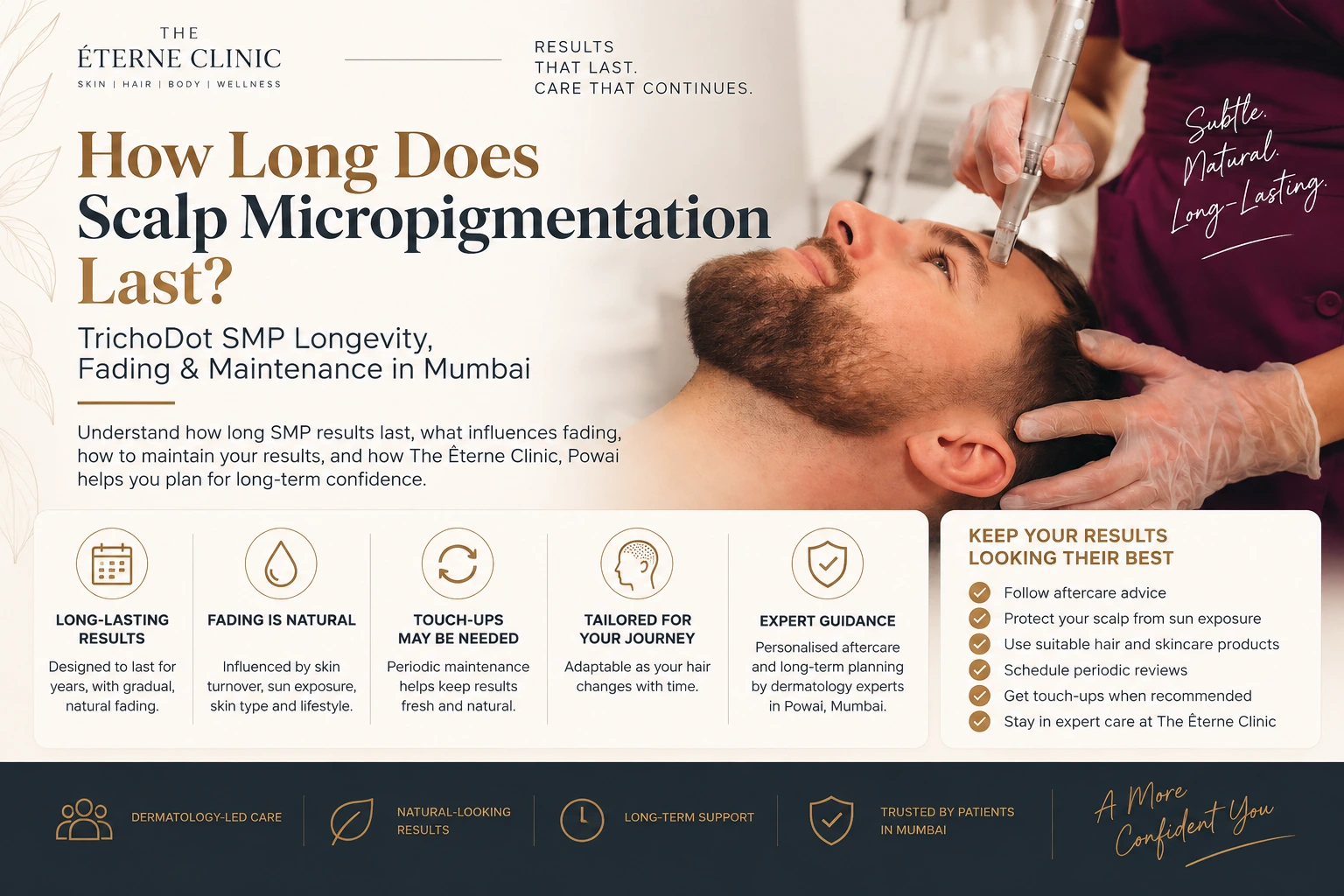
How Long Does Scalp Micropigmentation Last? A Complete Guide to TrichoDot SMP Longevity, Fading and Touch-Ups
If you're considering scalp micropigmentation in Mumbai, one question naturally comes before committing to treatment:
"How long will my SMP last?"
It's an important question—but there's no single expiry date that applies to every scalp.
Scalp micropigmentation is intended to provide a long-lasting cosmetic effect, but pigment appearance can gradually change with time.
Your skin is biologically active. It renews itself. It's exposed to ultraviolet radiation, skincare products, sweat, environmental conditions and natural ageing.
Meanwhile, your hair may also continue to thin, turn grey or change in distribution.
So rather than thinking of TrichoDot Advanced Scalp Micropigmentation as a treatment that remains frozen in time, it's more accurate to think of it as a long-term cosmetic result that can be reviewed, refreshed and adapted as you age.
At The Éterne Clinic, Powai, Mumbai, this long-term planning begins before the first micro-pigment impression is placed.
First, What Is TrichoDot Scalp Micropigmentation?
TrichoDot is our advanced approach to scalp micropigmentation for men and women.
Carefully selected pigment is deposited as tiny impressions within areas of the scalp where greater visual density is desired.
Depending on the patient's hair-loss pattern, it may be used to:
- Simulate closely cropped follicles
- Reduce scalp visibility between existing hairs
- Enhance the appearance of density
- Camouflage a widening part
- Improve crown appearance
- Define a receding hairline
- Camouflage selected hair transplant scars
TrichoDot does not create new follicles.
Instead, it creates optical density by reducing the contrast between hair and scalp.
Is Scalp Micropigmentation Permanent?
Patients often see conflicting answers online.
Some websites call SMP permanent. Others call it semi-permanent.
From a practical perspective, it's better to think of scalp micropigmentation as long-lasting but subject to gradual fading and change.
Pigment may remain detectable for years, but its:
- Intensity
- Sharpness
- Contrast
- Integration with surrounding hair
can evolve over time.
This is one reason periodic review and, when appropriate, touch-up treatment can be useful.
Why Does SMP Fade?
Several biological and environmental factors influence pigment appearance.
1. Natural Skin Turnover
Your scalp isn't an inert surface.
Skin continuously renews itself, and biological processes can gradually alter the appearance of deposited pigment.
Different individuals have different skin characteristics, which means pigment retention can vary.
2. Sun Exposure
Mumbai sunshine matters.
Ultraviolet exposure can influence pigmentation over time, particularly on an exposed or closely shaved scalp.
Men who maintain a very short hairstyle may therefore need to be particularly mindful of sun protection.
Appropriate hats and dermatologist-recommended sunscreen can help protect exposed scalp.
Sun protection isn't merely about preserving SMP.
It also helps protect the skin itself.
3. Skin Type
Oily, dry and combination scalps can behave differently.
Factors such as:
- Sebum production
- Skin turnover
- Scalp sensitivity
- Inflammation
may influence healing and long-term pigment appearance.
This is one reason an individual assessment is preferable to assuming every patient's SMP will age identically.
4. Pigment Depth
Depth is one of the most important technical elements of scalp micropigmentation.
Pigment placed incorrectly can heal unpredictably.
If impressions are too superficial, retention may be inadequate.
If they are placed too deeply, dots may become less defined or potentially appear unnatural.
The aim is controlled, precise placement appropriate for scalp micropigmentation.
5. Lifestyle
A patient's routine may also influence long-term appearance.
Frequent exposure to:
- Strong sunlight
- Outdoor environments
- Certain scalp treatments
- Skin-resurfacing procedures
may affect pigment over time.
Patients should therefore inform their dermatologist or aesthetic practitioner about their SMP before undergoing future scalp procedures.
6. Your Hair Keeps Changing
This is perhaps the most overlooked factor.
The pigment may remain relatively stable while the hair around it changes.
Male and female pattern hair loss are progressive conditions.
A patient may undergo SMP at 35 and lose additional native hair over the next several years.
Similarly, hair may become grey.
That means an SMP design that blends perfectly today may eventually require modification as the biological hair changes.
Why Long-Term Planning Matters Before SMP
Imagine creating an extremely low, perfectly straight, dark hairline for a 28-year-old man with early male pattern baldness.
It may initially satisfy his desire for a youthful hairline.
But what happens if his native hair recedes significantly over the next decade?
The pigmentation may no longer integrate naturally.
That's why TrichoDot hairline design should consider future hair loss, not simply the patient's appearance on treatment day.
A slightly conservative hairline can often age far more gracefully.
Is Fading Actually a Bad Thing?
Not always.
Patients often assume that the longest-lasting possible pigment must automatically be the best pigment.
But aesthetics change.
Your:
- Hairline
- Hair colour
- Hair density
- Facial proportions
- Personal hairstyle
can all evolve.
Controlled fading creates an opportunity to adapt the treatment rather than being permanently locked into an aesthetic decision made many years earlier.
When Might I Need an SMP Touch-Up?
There's no universal schedule.
Some patients maintain an acceptable cosmetic result for a long period, while others may prefer an earlier refresh.
A touch-up may be considered when:
- Pigment has visibly softened
- Hair loss has progressed
- Greater density is desired
- Hair colour has changed
- A treated scar has faded differently
- The patient wants refinement of a particular area
The decision should be based on the appearance of the scalp rather than an arbitrary calendar date.
What Happens During a TrichoDot Touch-Up?
A touch-up doesn't necessarily mean repeating the entire original procedure.
The scalp is reassessed.
Areas with reduced visual density can be identified, and additional pigment impressions may be introduced where appropriate.
This can allow treatment to evolve with the patient's changing hair.
Why You Shouldn't Keep Making SMP Darker
A common misconception is that every maintenance session should make the scalp darker.
That's not the goal.
The objective is integration.
If existing SMP already looks natural, unnecessary additional pigment may reduce subtlety.
Touch-ups should therefore be strategic rather than automatic.
How Does TrichoDot Age in Men?
For men with a shaved-head SMP effect, several factors become important over time.
Natural hair may:
- Recede further
- Become thinner
- Turn grey
- Become white
The SMP needs to remain visually compatible with these changes.
This is why the initial pigment shade and hairline shouldn't be excessively aggressive.
Learn more in our dedicated guide on Scalp Micropigmentation for Men.
How Does TrichoDot Age in Women?
Female density SMP presents a different situation.
The pigmentation is typically concealed between longer existing hairs.
If female pattern hair loss progresses, more scalp may become exposed around the originally treated area.
The patient may therefore require:
- Additional medical treatment
- Extension of density SMP
- Regenerative therapy
- Hair transplantation in selected cases
Female SMP should therefore form part of a long-term hair-loss plan.
Explore our dedicated guide on Scalp Micropigmentation for Women.
Can Medical Hair-Loss Treatment Help Protect an SMP Result?
Indirectly, yes.
Remember: SMP doesn't stop hair loss.
If a patient successfully stabilizes native hair, the visual relationship between the pigment and surrounding follicles may remain more consistent.
Depending on diagnosis and suitability, medical management may include:
- Minoxidil
- Finasteride in appropriate male patients
- Dermatologist-directed scalp therapy like Combat 98™
- Nutritional correction
- Other medical or regenerative treatments
TrichoDot addresses the cosmetic component.
Medical treatment addresses the biological condition.
What About QR678, PRP and Regenerative Hair Treatments?
Selected patients may combine TrichoDot with regenerative hair treatments.
The important distinction is that these treatments serve different purposes.
TrichoDot: optical density.
Regenerative treatment: aims to support existing follicular health in suitable patients.
Hair transplant: relocates actual follicles.
Understanding these distinctions prevents unrealistic expectations.
Learn more about QR678 and Exosome Therapy.
Can I Have a Hair Transplant After SMP?
Potentially, yes.
Previous SMP doesn't automatically prevent a patient from undergoing hair transplantation.
However, the surgeon needs to assess:
- Existing pigment
- Actual follicular density
- Donor availability
- Pattern of hair loss
- Desired hairline
This is another reason why TrichoDot should be designed with future options in mind.
Compare both procedures in our guide: Hair Transplant vs Scalp Micropigmentation.
Can I Have TrichoDot After a Hair Transplant?
Yes, selected patients may benefit from this approach.
Even after transplantation, scalp may remain visible between hairs, particularly under strong lighting.
TrichoDot can sometimes enhance visual density without consuming additional donor follicles.
The transplant creates actual hair.
TrichoDot can enhance the optical background.
FAAST Hair Transplant + TrichoDot for Long-Term Planning
For some patients, modern hair restoration works best when techniques are strategically combined.
A patient with limited donor reserves may use FAAST Hair Transplant to create actual hair in cosmetically important areas.
TrichoDot may subsequently reduce scalp visibility between follicles.
This allows each treatment to do what it does best.
Rather than asking one procedure to solve every problem, we can approach hair restoration in layers.
How Can I Help My SMP Last Well?
Aftercare matters.
Patients should follow their clinician's instructions carefully after treatment.
Depending on the stage of healing, guidance may cover:
- Scalp washing
- Exercise
- Sweating
- Swimming
- Sun exposure
- Scalp products
Once the scalp has healed, sensible UV protection becomes particularly important for exposed areas.
Should I Apply Sunscreen to My Scalp?
If your scalp is exposed, sun protection is generally sensible for overall skin health.
The exact sunscreen and application method should be selected according to scalp characteristics, hairstyle and dermatological advice.
Patients with longer hair can also use physical protection such as hats where appropriate.
What Should I Avoid Immediately After SMP?
Specific aftercare varies according to the procedure and individual patient.
Generally, patients receive instructions regarding temporary avoidance of excessive:
- Sweating
- Swimming
- Scalp friction
- Sun exposure
- Certain hair or scalp products
Following your treatment team's instructions is more appropriate than relying on generic internet advice.
Can Anti-Dandruff Treatments Affect SMP?
Patients with dandruff or seborrhoeic dermatitis often use medicated shampoos and scalp treatments.
These conditions should ideally be controlled before micropigmentation.
If you're using prescription or active scalp products, tell your treating clinician before and after SMP so your scalp-care routine can be appropriately planned.
Why Scalp Health Matters for Pigment Longevity
Healthy skin generally provides a more predictable environment for cosmetic procedures.
Active:
- Dermatitis
- Infection
- Inflammation
- Scalp disease
may interfere with treatment planning and healing.
At The Éterne Clinic, SMP isn't viewed independently of scalp health.
The scalp is examined first.
Does SMP Change Colour Over Time?
Pigment appearance can change as it fades, which makes appropriate pigment selection and technique important.
Patients worried about unnatural colour change should ask about:
- Pigment selection
- Technique
- Depth
- Expected fading
- Maintenance strategy
The objective is for TrichoDot to soften naturally rather than become conspicuous.
What If I Turn Grey?
This is an excellent long-term planning question.
Hair colour changes with age.
A dark SMP treatment shouldn't be designed without considering that possibility.
For shaved-head SMP, pigment generally represents the shadow of a follicle beneath the skin, rather than attempting to replicate the full colour of a long hair shaft.
Nevertheless, future greying should be considered when planning shade and density.
Can SMP Be Removed?
Because scalp micropigmentation is designed to be long-lasting, patients should consider treatment carefully.
Correction or removal of unwanted pigmentation can be more complex than creating an appropriate result initially.
This is another reason to avoid:
- Excessively low hairlines
- Very dark pigmentation
- Overly large dots
- Aggressive density
Conservative planning gives the treatment greater flexibility as the patient ages.
Why Choose TrichoDot at The Éterne Clinic, Powai?
A good SMP treatment shouldn't only look appropriate immediately after healing.
It should be designed to age appropriately.
At The Éterne Clinic, Powai, Mumbai, TrichoDot planning considers:
- Current hair density
- Diagnosis
- Future hair-loss progression
- Skin characteristics
- Hair colour
- Hairline design
- Previous hair transplantation
- Potential future surgical options
Patients searching for scalp micropigmentation in Powai, Hiranandani Powai or Mumbai should consider long-term planning as seriously as the immediate before-and-after result.
The Bigger Picture: SMP Is Part of a Hair Journey
Hair restoration isn't a single event.
A 30-year-old man with early androgenetic alopecia may have completely different needs at 45.
A woman with early widening of the part may experience further thinning after menopause.
That's why TrichoDot should fit into a broader strategy that may include:
- Medical treatment → preserving hair
- Regenerative therapy → supporting suitable existing follicles
- FAAST Hair Transplant → restoring actual follicles
- TrichoDot → enhancing visual density
The ideal combination varies from patient to patient.
Final Thoughts
So, how long does scalp micropigmentation last?
The most accurate answer is that TrichoDot is designed to provide a long-lasting cosmetic result, but its appearance can gradually soften and evolve.
There is no single guaranteed lifespan because pigment retention depends on the skin, sun exposure, technique, lifestyle, aftercare and—critically—the progression of the patient's natural hair loss.
Rather than chasing an unnaturally permanent result, the better goal is SMP that looks natural today and can be intelligently adapted tomorrow.
At The Éterne Clinic, Powai, Mumbai, that's the philosophy behind TrichoDot: not merely creating pigment impressions, but planning how those impressions will continue to work with your hair as it changes.
Explore our related hair restoration blogs:
- Scalp Micropigmentation in Mumbai: What Is TrichoDot and Who Is It For?
- Scalp Micropigmentation for Men in Mumbai: TrichoDot for Male Pattern Baldness
- Scalp Micropigmentation for Women in Mumbai: TrichoDot for Female Hair Loss
- Scalp Micropigmentation Without Shaving in Mumbai: TrichoDot SMP for Thinning Hair
- Scalp Micropigmentation Cost in Mumbai: TrichoDot SMP Price, Sessions & Results
- Hair Transplant vs Scalp Micropigmentation: Which Is Right for You?
- Why FAAST™ is Better Than FUE & FUT Hair Transplants?
- QR678 Therapy for Hair Loss in Mumbai: Growth Factor Treatment for Hair Regrowth
Medical & Legal Disclaimer
This article is purely for educational and informational purposes and does not constitute medical advice, diagnosis, treatment recommendation or a guarantee of results or treatment longevity. TrichoDot Scalp Micropigmentation is a cosmetic camouflage procedure and does not create new follicles, biologically regrow hair or prevent progressive hair loss. Pigment appearance, retention, fading, number of sessions, touch-up requirements, downtime and potential risks vary between individuals and depend on multiple factors, including skin characteristics, treatment technique, sun exposure, aftercare and progression of hair loss. Patients with active or unexplained scalp conditions should undergo appropriate medical evaluation. Consultation with a qualified healthcare professional is essential before undergoing scalp micropigmentation or any medical, regenerative or surgical hair-restoration procedure.