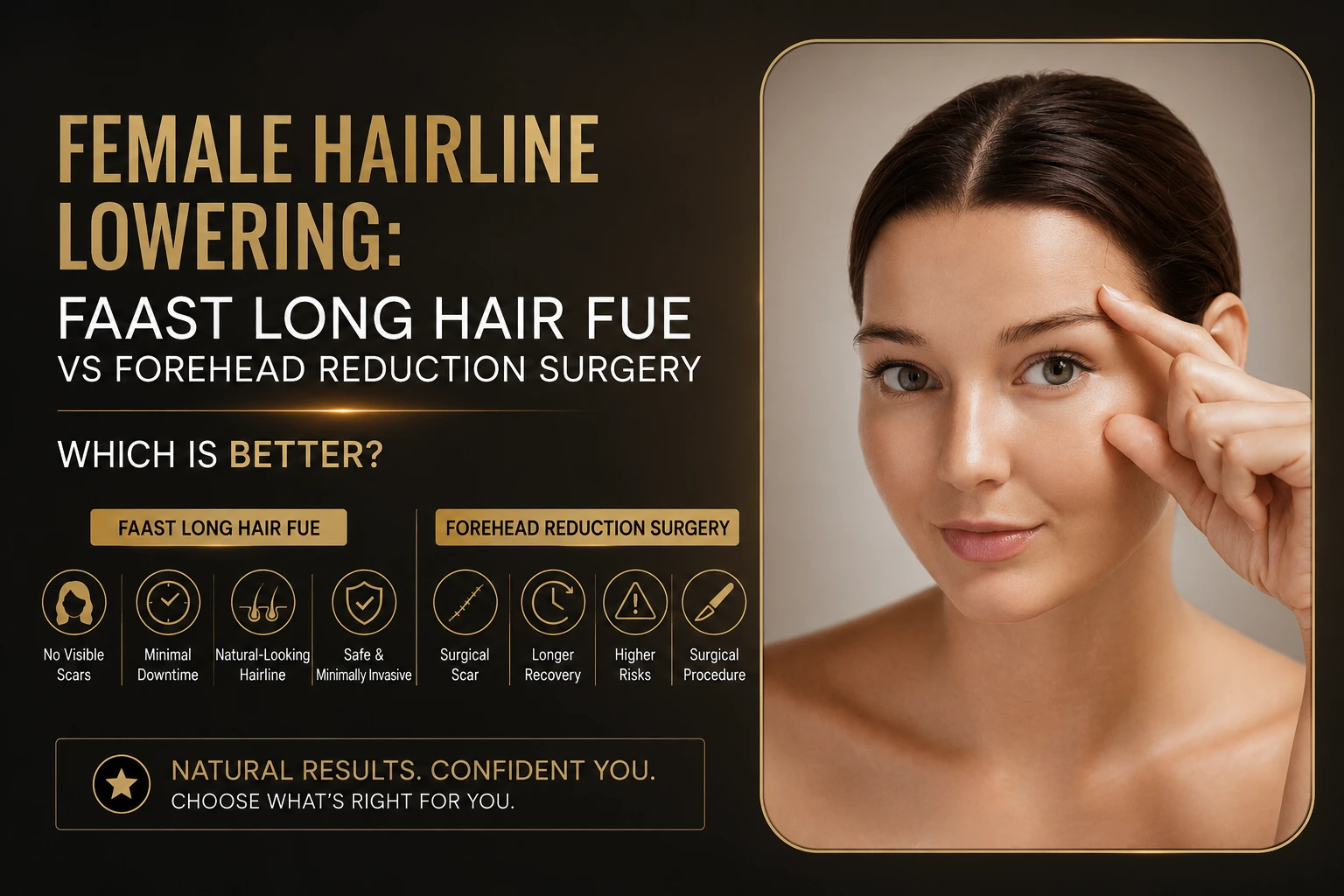
Female Hairline Lowering: FAAST Long Hair FUE vs Forehead Reduction Surgery – Which Is Better?
For many women, a high forehead is not simply an aesthetic concern.
It often affects:
- Facial proportions
- Hairstyle choices
- Confidence in photographs
- Makeup preferences
- Overall facial harmony
Many women spend years hiding their forehead using:
- Fringes
- Bangs
- Strategic hairstyles
- Hair fibers
- Scalp concealers
The good news is that modern medicine offers effective solutions.
Historically, forehead reduction surgery was considered the primary option for lowering a high hairline.
Today, many women are increasingly choosing FAAST Long Hair FUE hairline lowering, a less invasive approach that offers natural results with significantly less disruption to daily life.
Why Does a High Forehead Matter?
Facial attractiveness is strongly influenced by proportion.
A disproportionately high forehead may create the appearance of:
- An elongated face
- Reduced facial balance
- Hairline recession even when hair density is normal
Many women seeking forehead reduction actually have healthy hair density but wish to improve facial proportions by bringing the hairline forward.
What Is Forehead Reduction Surgery?
Forehead reduction surgery, also called surgical hairline advancement, is a plastic surgery procedure.
The procedure involves:
- Making an incision along the frontal hairline
- Surgically removing a strip of forehead skin
- Pulling the scalp forward
- Suturing the scalp into a lower position
This physically reduces forehead height immediately.
Advantages of Forehead Reduction Surgery
Immediate Hairline Advancement
The hairline can often be
moved forward significantly in a single procedure.
Useful for Selected Patients
Particularly those with:
- Good scalp laxity
- Stable hairline
- Minimal future hair loss risk
Limitations of Forehead Reduction Surgery
While effective in selected cases, forehead reduction surgery remains a surgical procedure and comes with important considerations.
Visible Surgical Scar
Although surgeons place the incision
along the hairline, a scar is unavoidable.
Most scars heal well, but some patients may experience:
- Visible scarring
- Irregular scar healing
- Scar widening
- Hypertrophic scars
This can become particularly concerning in women who prefer hairstyles exposing the forehead.
Longer Recovery
Compared with hair transplantation, recovery
may involve:
- Swelling
- Bruising
- Tightness
- Temporary numbness
Many patients require a longer social recovery period.
Surgical Risks
As with any surgical procedure, potential
risks include:
- Bleeding
- Infection
- Delayed wound healing
- Temporary scalp numbness
- Hair loss along the incision line
Although uncommon, these possibilities must be discussed during consultation.
Limited Ability to Refine Hairline Shape
Forehead reduction
surgery moves the existing hairline forward. However, it may not create the
soft, feminine irregularities that characterize a natural female hairline.
What Is Hairline Lowering with FAAST Long Hair FUE?
FAAST Long Hair FUE takes an entirely different approach.
Rather than surgically moving the scalp, it creates a new hairline by transplanting individual follicles.
The procedure uses:
- Long hair grafts
- Sapphire blade implantation
- Precision hairline artistry
- Advanced follicular unit extraction
to gradually lower and reshape the hairline.
The Biggest Advantage: No Visible Scar
One of the most significant benefits of FAAST Long Hair FUE is the absence of a linear forehead scar.
Instead of creating a surgical incision:
- Individual grafts are strategically implanted
- Hairline density is built naturally
- The forehead appears smaller through natural framing
For many women, this is a major advantage.
No Visible Shaving
Traditional hair transplant techniques often require shaving. This has discouraged many women from considering hair restoration.
FAAST Long Hair FUE changes that. The procedure is specifically designed to:
- Preserve existing hairstyles
- Maintain hair length
- Minimize cosmetic disruption
- Allow discreet recovery
Most people around the patient never realize a procedure has been performed.
Recovery: FAAST vs Forehead Reduction Surgery
Forehead Reduction Surgery
Recovery may involve:
- Swelling for several days
- Bruising
- Tightness
- Visible incision line
- Longer healing period
Patients often require more social downtime.
FAAST Long Hair FUE
Most patients experience:
- Minimal swelling
- Mild redness
- Rapid return to routine activities
Many professional women resume work and social engagements within a few days.
Which Creates the Most Natural Hairline?
A natural female hairline is rarely perfectly straight.
It contains:
- Micro-irregularities
- Soft transitions
- Variable follicular density
With FAAST Long Hair FUE, every follicular unit can be placed individually.
This allows:
- Customization
- Facial balancing
- Natural density gradients
- Artistic refinement
The result often appears indistinguishable from naturally occurring hair.
What About Future Hair Loss?
This is an important but often overlooked consideration.
If a woman experiences future hairline recession after forehead reduction surgery:
- The surgical scar may become more visible
- The advanced hairline may not age naturally
With FAAST Long Hair FUE:
- Future enhancements are possible
- Hairline design can be adapted over time
- Additional density can be added if required
This provides greater long-term flexibility.
Who Is a Better Candidate for FAAST Long Hair FUE?
Women who often prefer FAAST include:
Corporate Professionals
Who cannot afford visible downtime.
Brides-to-Be
Seeking a softer, lower hairline before
important events.
Models and Public Figures
Who require maximum discretion.
Women Concerned About Scarring
Who wish to avoid a surgical
forehead incision.
Patients Seeking Hairline Refinement
Rather than dramatic
scalp advancement.
FAAST Long Hair FUE vs Forehead Reduction Surgery: Quick Comparison
| Feature | Forehead Reduction Surgery | FAAST Long Hair FUE |
|---|---|---|
| Surgical incision | Yes | No |
| Linear scar | Permanent scar possible | No linear scar |
| Visible shaving | No | No |
| Hairline customization | Limited | Highly customizable |
| Natural hairline artistry | Moderate | Excellent |
| Recovery | Longer | Faster |
| Social downtime | Higher | Minimal |
| Ability to refine later | Limited | Easy |
| Hairline density enhancement | No | Yes |
| Immediate aesthetic blending | Limited | Excellent |
Why More Women Are Choosing FAAST Long Hair FUE
Modern women want results that fit into real life.
They want:
- Natural outcomes
- Minimal downtime
- No obvious surgery
- No visible scar
- Preservation of existing hairstyle
- Long-term flexibility
FAAST Long Hair FUE delivers on all of these expectations.
For many women, it offers the perfect balance between aesthetic enhancement and everyday practicality.
Final Thoughts
Forehead reduction surgery remains an effective option for selected patients.
However, many women today are seeking a less invasive solution that prioritizes natural aesthetics, discretion, and minimal downtime.
FAAST Long Hair FUE allows surgeons to lower and redesign the hairline follicle by follicle, creating a softer, more feminine appearance without a visible scar or major interruption to daily life.
For women who want a smaller forehead without looking like they’ve had surgery, FAAST Long Hair FUE is rapidly becoming the preferred choice.
Read more from our FAAST & Hair Restoration blog series:
- FAAST Long Hair FUE vs. Standard Hair Transplant: What Makes It Different?
- FAAST Long Hair FUE with Sapphire Blade Slitting: Achieving Maximum Density
- Why Corporate Professionals Are Choosing FAAST Long Hair FUE
- Hair Transplant for Women
- Female Pattern Hair Loss & Balding
Disclaimer
This article is intended solely for educational and informational purposes and should not be construed as medical advice, diagnosis, treatment recommendation, or a substitute for professional healthcare consultation. Treatment suitability varies between individuals. Forehead reduction surgery and hair transplantation each have unique indications, benefits, limitations, and potential risks. A detailed consultation with a qualified medical professional is essential before deciding on any surgical or non-surgical treatment.