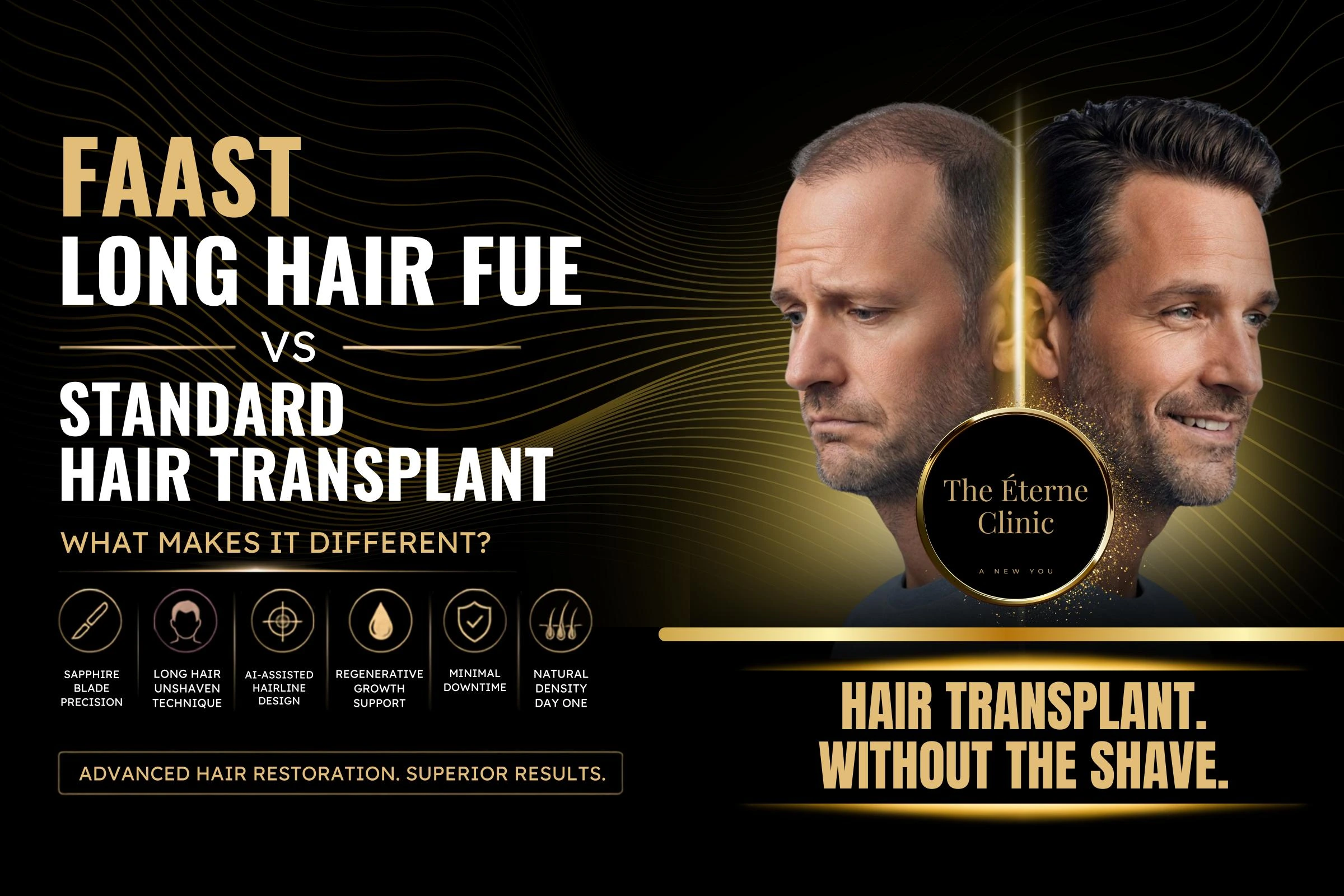
FAAST Long Hair FUE vs. Standard Hair Transplant: What Makes It Different?
Hair restoration science has evolved beyond the one-size-fits-all approach of traditional hair transplants. Modern patients — especially public personalities and those with busy lives — need discreet solutions that look natural from day one.
FAAST Long Hair FUE (Follicle Activated Advanced Synchronized Transplant) is an advanced hair transplant protocol offered at The Éterne Clinic in Mumbai. It blends cutting-edge tools, sophisticated planning and regenerative science to deliver immediate density and long-term success.
In this blog we explore how FAAST differs from a regular hair transplant, why the use of a sapphire blade is important, and the key features that make this technique popular with celebrities and professionals alike.
What Is FAAST Long Hair FUE?
FAAST — short for Follicle Activated Advanced Synchronized Transplant — is an enhanced form of Follicular Unit Extraction. Traditional FUE involves shaving the donor and recipient areas, extracting grafts one by one and implanting them into bald zones. FAAST retains the key benefit of FUE (minimally invasive extraction) but introduces innovations that enhance both the procedure and its outcome:
Long Hair FUE
Grafts are harvested with the hair shafts
intact. This means the transplanted hairs are visible immediately after surgery,
giving patients a preview of how the density will look without waiting for
months. There is no shaving of the donor or recipient areas.
Regenerative Integration
Growth factor concentrates,
autologous plasma (PRP/iPRF) and exosome
therapy are used before and after the transplant to reduce inflammation
and support graft survival.
Sapphire Blade Slits
Instead of the standard steel scalpel,
FAAST uses ultra-fine sapphire blades to make recipient site incisions (slits).
Sapphire blades create cleaner, smaller channels that minimise bleeding, reduce
trauma and improve graft handling.
FAAST Protocol
The term “synchronised” in FAAST
refers to the precise coordination between extraction and implantation. The team
works in tandem so that grafts spend minimal time outside the body, improving
viability.
How FAAST Differs from a Standard Hair Transplant
A conventional FUE or FUT hair transplant typically involves shaving the scalp, using steel blades for slits and transplanting short-hair grafts. While effective, it requires weeks of social downtime and the final results are not visible until the hair grows out. FAAST introduces several upgrades:
- Shaving Requirement: Standard FUE/FUT — donor and recipient areas shaved. FAAST — completely unshaven; long hair grafts.
- Hair Shaft Length: Standard — grafts trimmed short. FAAST — grafts implanted with full-length hair.
- Incision Technique: Standard — steel or titanium blades. FAAST — micro-slits created with sapphire blades.
- Planning: Standard — manual hairline design. FAAST — AI-assisted trichoscopy & hair simulation.
- Recovery & Downtime: Standard — visible signs of surgery for 10–14 days. FAAST — minimal downtime; undetectable after 3–4 days.
- Immediate Aesthetic Result: Standard — no; density emerges after months. FAAST — yes; hairline and density visible day one.
- Regenerative Support: Standard — optional PRP. FAAST — integrated PRP/iPRF/exosome therapy.
- Suitability: Standard — mostly male pattern baldness. FAAST — suitable for men and women, crown and hairline correction.
- Ideal Candidates: Standard — patients who can shave the scalp. FAAST — celebrities, professionals, brides/grooms.
Sapphire Blade versus Steel Blade
The material used to make
recipient slits can influence the outcome. Standard blades are often made of
surgical steel; they are effective but can cause more trauma and require thicker
incisions. Sapphire blades are crafted from a crystalline gemstone — they
remain sharper for longer and allow the surgeon to create
micro-channels with minimal bleeding. These narrower incisions
reduce tissue damage, allow denser graft placement and promote faster healing.
In FAAST, using sapphire blades helps achieve a natural hairline with less
scarring.
Other Key Aspects of FAAST
Discreet Procedure
Since there is no shaving, patients
maintain their hairstyle before and after surgery. This makes FAAST ideal for
those who cannot explain a shaved scalp to peers or the public.
Faster Healing
Smaller incisions and synchronised
implantation mean less post-operative swelling and a quicker return to daily
activities.
Personalised Design
The AI-assisted planning tool simulates
future hairline patterns and ensures the hairline is age-appropriate and
balanced with facial features. Each procedure is customised.
High Graft Survival
Grafts spend less time outside the body,
are kept in optimal temperature and nutrient solutions, and benefit from the
regenerative therapies used during the procedure. This improves the percentage
of hairs that successfully take root.
Combination Approach
FAAST is often paired with treatments
like DHT-blocking medications, topical growth serums, low-level laser therapy
and customised supplementation to address ongoing hair loss.
Minimal Donor Scarring
As a form of FUE, FAAST uses
micro-punches (often less than 0.8 mm). There is no linear scar and the donor
area heals quickly.
Who Should Consider FAAST Over a Standard Transplant?
While FAAST offers numerous benefits, it may not be necessary for everyone. Ideal candidates include:
Public Figures
Actors, models, influencers, musicians and
news anchors who need to return to the spotlight without visible signs of
surgery.
Women with Diffuse Thinning
Female pattern
hair loss often requires transplanting between existing hairs. Long Hair
FUE allows seamless blending without shaving.
Individuals with Limited Downtime
Busy executives,
entrepreneurs or brides/grooms preparing for a wedding who can’t take time
off for visible healing.
Patients Seeking Hairline Refinement
Those with a high
forehead or receding temples wanting to lower or redefine the hairline
discreetly.
Return Patients
People who have had a previous transplant and
need density improvement without shaving the existing grafts.
Conclusion
FAAST Long Hair FUE at The Éterne Clinic is more than just a hair transplant. It is a comprehensive hair restoration protocol that combines surgical precision, sapphire blade micro-slits, AI-driven planning and regenerative science. By allowing long hair grafts to be placed without shaving, FAAST delivers natural-looking results immediately after the procedure and minimises social downtime. For celebrities and anyone seeking the highest level of discretion, FAAST represents a major advancement over standard hair transplant techniques.